Saint Library
January 1patristicUniversal

Basil of Caesarea

Doctor of the Church

Sanctified Life

330379

Province of Cappadocia, Roman Empire

Patronage

RussiaCappadociahospital administratorsreformersmonkseducationexorcismliturgists

""

Basil of Caesarea, also called Saint Basil the Great (330 – 1 or 2 January 379), was an early Roman Christian prelate who served as Bishop of Caesarea Mazaca in Cappadocia from 370 until his death in 379. He was an influential theologian who supported the Nicene Creed and opposed heresies within the early Christian church such as Arianism and Apollinarianism. In addition to his work as a theologian, Basil was known for his care of the poor and underprivileged. Basil established guidelines for monastic life which focus on community life, liturgical prayer, and manual labor. Together with Pachomius, he is remembered as a father of communal monasticism in Eastern Christianity. He is considered a saint by the traditions of both Eastern and Western Christianity.

Basil of Caesarea
Historical Legacy

Historical Journey

Historical Context
Basil of Caesarea (330–379), known as Basil the Great, was one of the most influential bishops of the fourth-century Church and a pivotal figure in the development of both Christian theology and organized monasticism. Together with his brother Gregory of Nyssa and his close friend Gregory of Nazianzus, he forms the trio known as the Cappadocian Fathers, whose theological work proved decisive in the final defeat of Arianism and the articulation of Trinitarian doctrine. Born into a remarkable family of saints in Caesarea, the capital of the Roman province of Cappadocia (in modern-day Turkey), Basil received the finest education available in the ancient world, studying rhetoric and philosophy in Constantinople and Athens, where he forged a lifelong friendship with Gregory of Nazianzus. After completing his studies, he toured the monastic communities of Egypt, Palestine, Syria, and Mesopotamia, and then retreated to the family estate in Pontus to live as a monk. Basil's monastic rules, emphasizing community life, liturgical prayer, manual labor, and care for the poor, became the foundation of Eastern monasticism and influenced the later Rule of St. Benedict in the West. As Bishop of Caesarea from 370, he organized a vast charitable complex outside the city — known as the 'Basiliad' — which included a hospital, hospice, poorhouse, and workshops. It was essentially the first large-scale Christian charitable institution, a forerunner of the modern hospital. Theologically, Basil's treatise 'On the Holy Spirit' provided the crucial arguments for the full divinity of the Holy Spirit, complementing the Nicene Creed's affirmation of the Son's divinity. His liturgical contributions endure in the Divine Liturgy of Saint Basil, still celebrated in Eastern Orthodox and Eastern Catholic churches. He died on January 1, 379, just two years before the Council of Constantinople would vindicate the Trinitarian theology he had championed. He is venerated as a Doctor of the Church in both East and West.
Canonization: saint
Learn More on Wikipedia

Historical Depiction

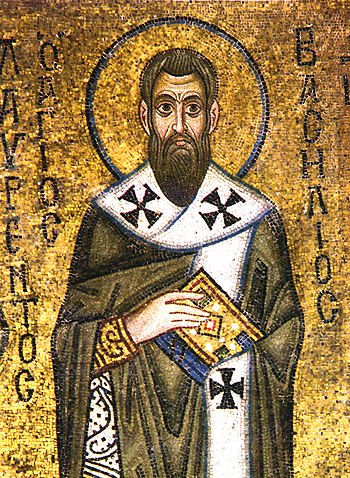
Historical depiction of Basil of Caesarea

Wikimedia Commons Source

Titles & Roles

TODO

Gallery

Basil of Caesarea
1 / 6

Basil of Caesarea

Unknown authorUnknown author • 11th century

Public domain

St. Basil the Great. Mosaic, Kiev Hagia Sophia, XI century.

Sacred Symbols

vested as_bishop

Vested as bishop

wearing omophorion

wearing omophorion

tapering black_beard.

tapering black beard.

Life Journey

330

Born in Province of Cappadocia, Roman...

Born in Province of Cappadocia, Roman Empire

379

Basil of Caesarea, also called Saint ...

Basil of Caesarea, also called Saint Basil the Great (330 – 1 or 2 January 379), was an early Roman Christian prelate who served as Bishop of Caesa...