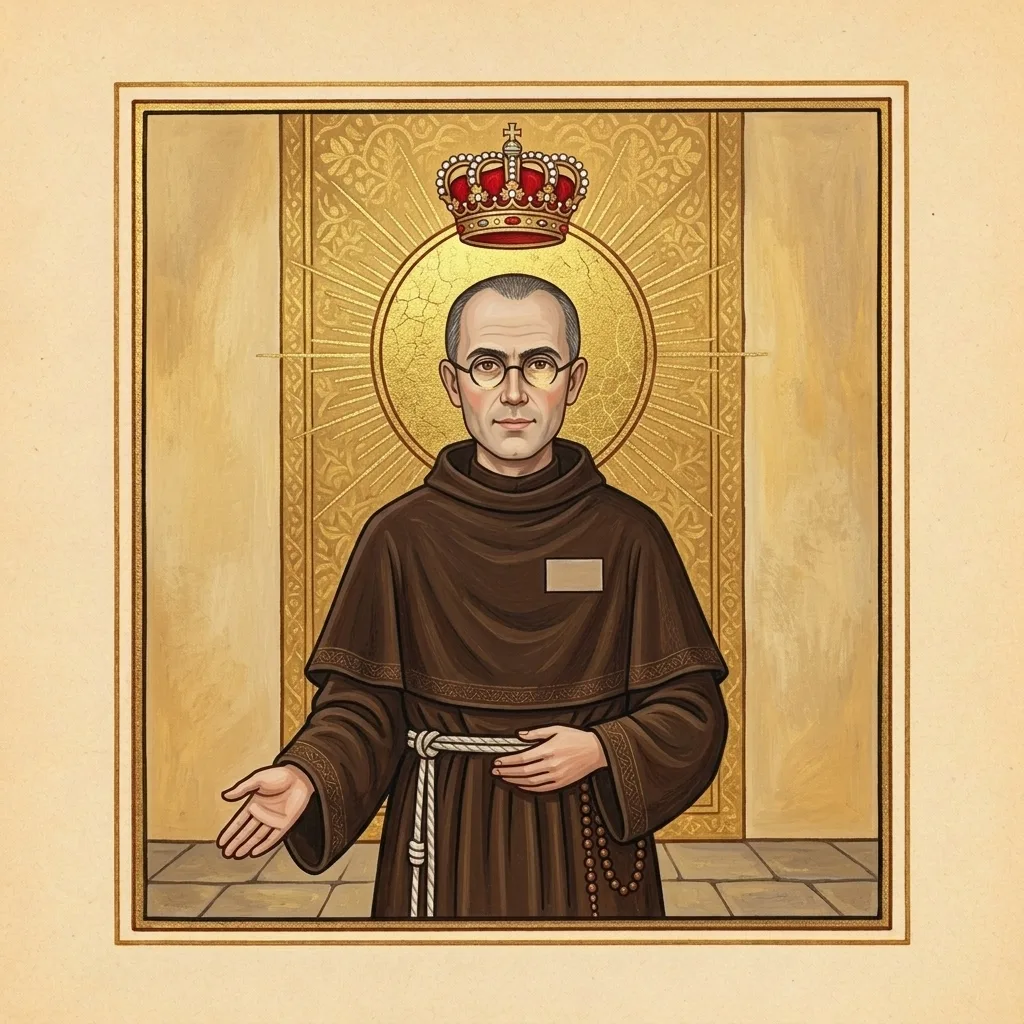
Maximilian Kolbe
Priest
Sanctified Life
1894 — 1941
Zduńska Wola, Poland
Also Known As
Patronage
"For Jesus Christ I am prepared to suffer still more."
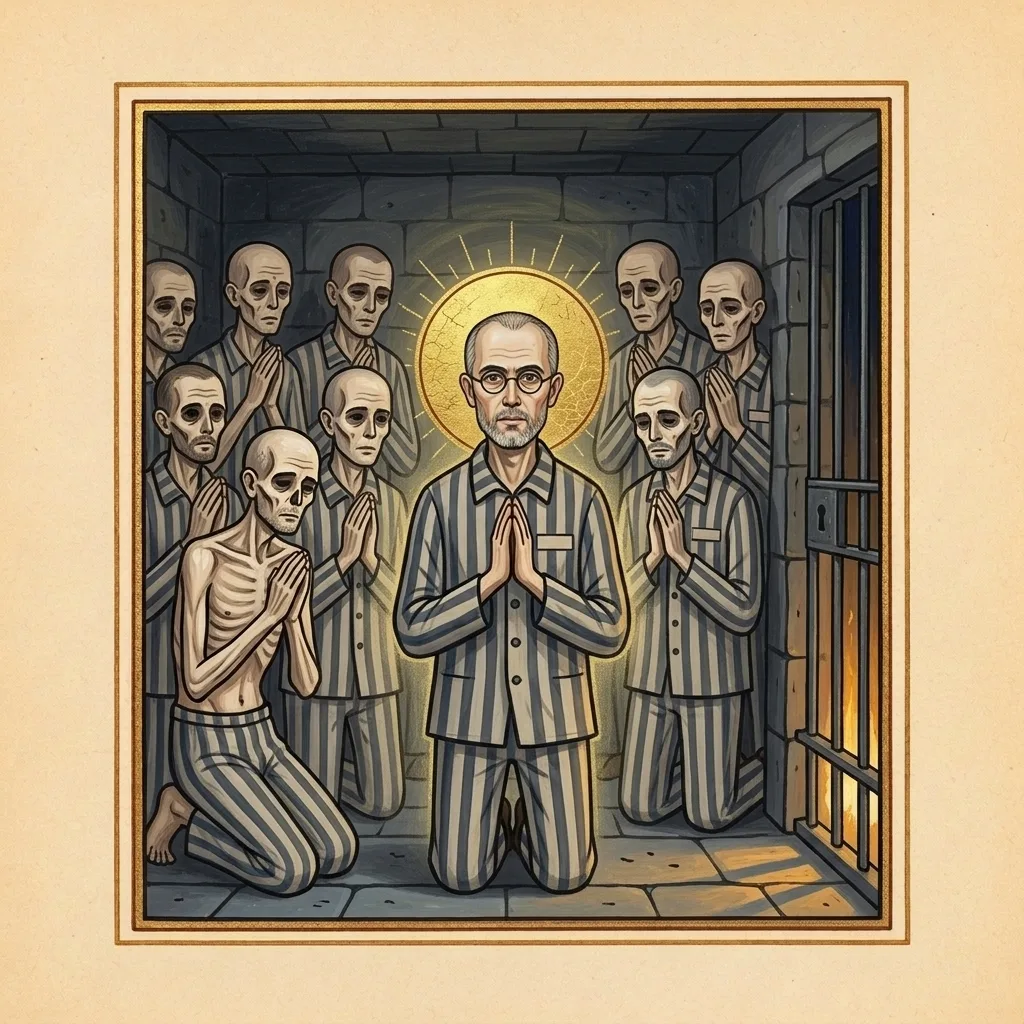
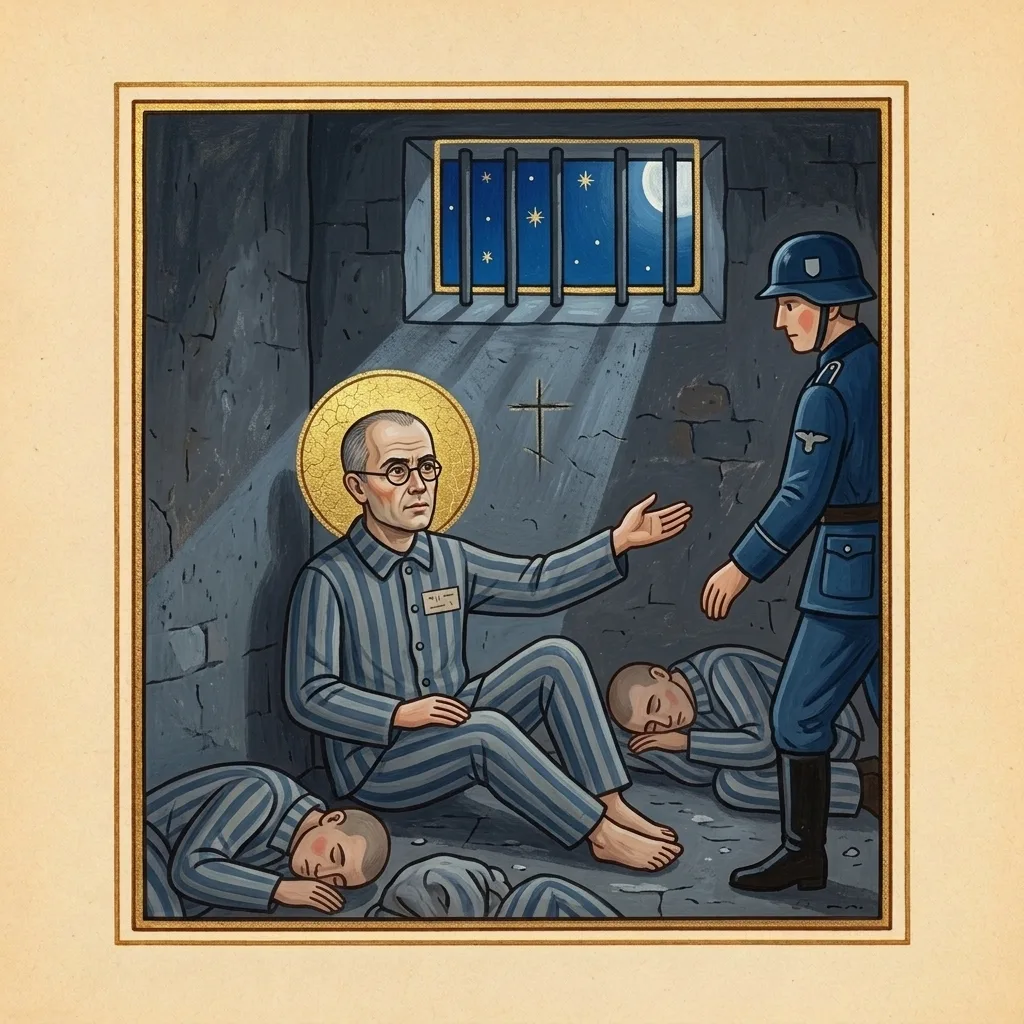
A Franciscan friar who used modern media to spread the Gospel, founding a massive monastery and publishing house in Poland. Arrested by the Nazis and sent to Auschwitz, he volunteered to die in place of a stranger, Franciszek Gajowniczek, who had a family. Thrown into a starvation bunker, he led the other prisoners in hymns and prayer, transforming a hellish cell into a chapel. He is known as the 'Martyr of Charity'.

Historical Journey
The Saint's Path
Historical Depiction

Camp identification photo of Maximilian Kolbe from Auschwitz concentration camp (1941).
Tradition
Titles & Roles
Writings
Prayers
Sacred invocations and spiritual gems from the heart of Maximilian Kolbe.
O Immaculata, Queen of Heaven and earth, refuge of sinners and our most loving Mother, God has willed to entrust the entire order of mercy to you. I, a repentant sinner, cast myself at your feet humbly imploring you to take me with all that I am and have, wholly to yourself as your possession and property. Please make of me, of all my powers of soul and body, of my whole life, death and eternity, whatever most pleases you.
Gallery

Todeszelle Pater Maximilian Kolbes, KZ Auschwitz I, Block 11
Dnalor 01 • 2004-04-02 12:20:14
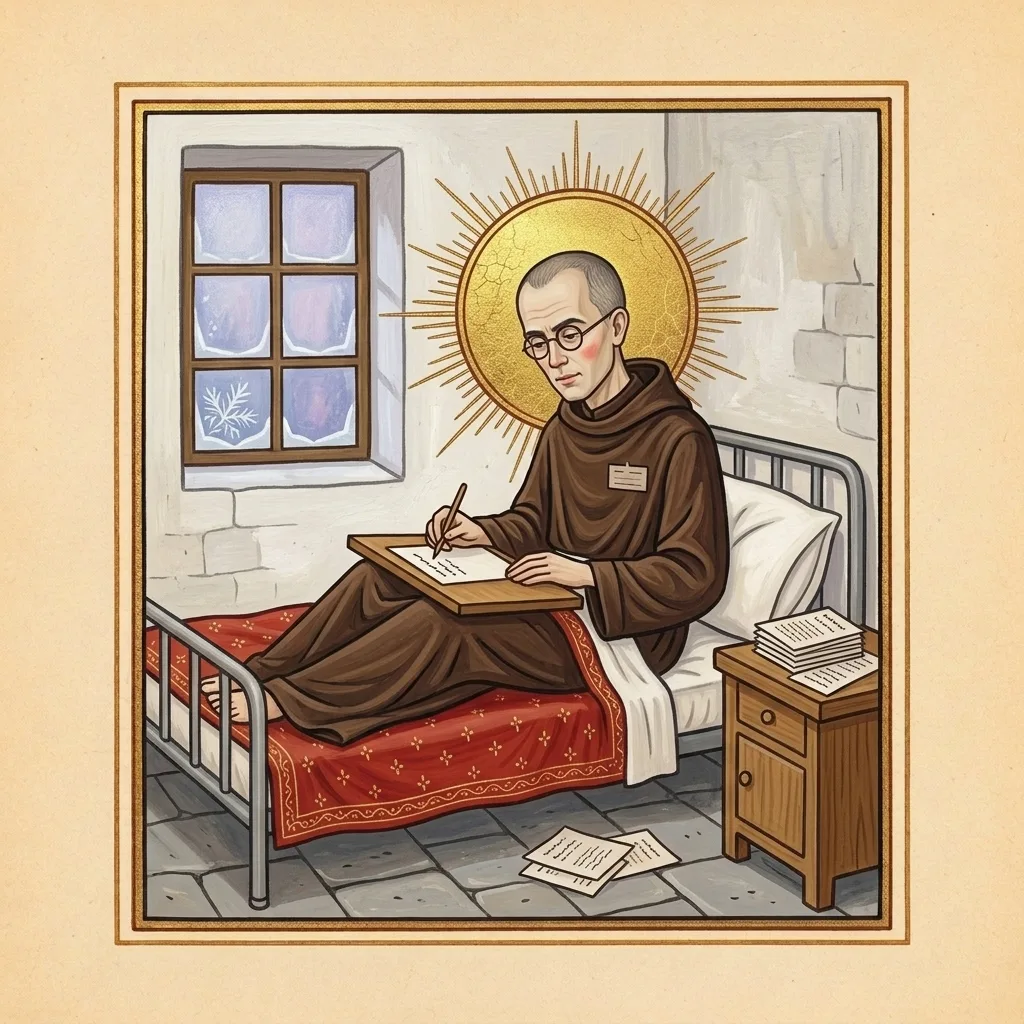
Maximilian Kolbe's prison cell in Block 11, Auschwitz concentration camp
Sacred Symbols
striped uniform
Solidarity with Prisoners
two crowns
Purity and Martyrdom
Life Journey
Born in Zduńska Wola
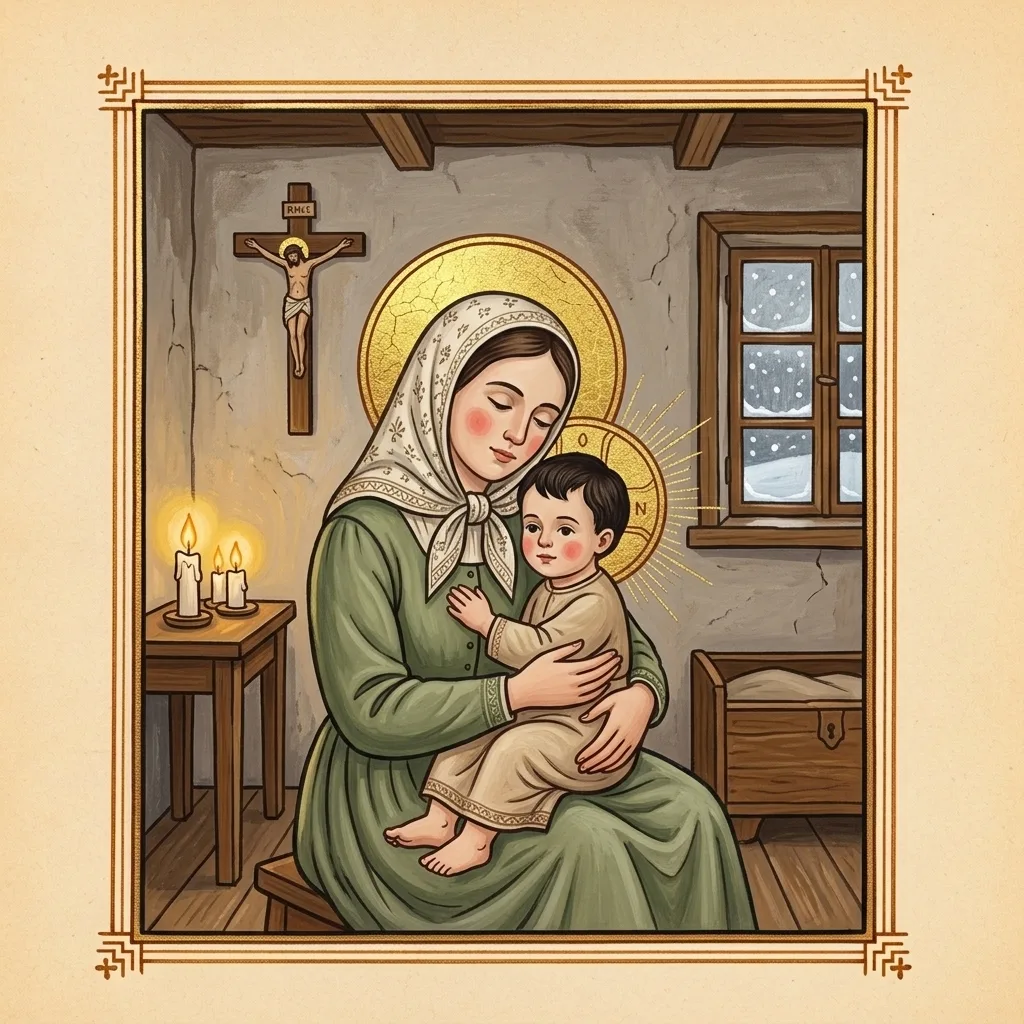
Born Rajmund Kolbe in Poland.
Two Crowns Vision
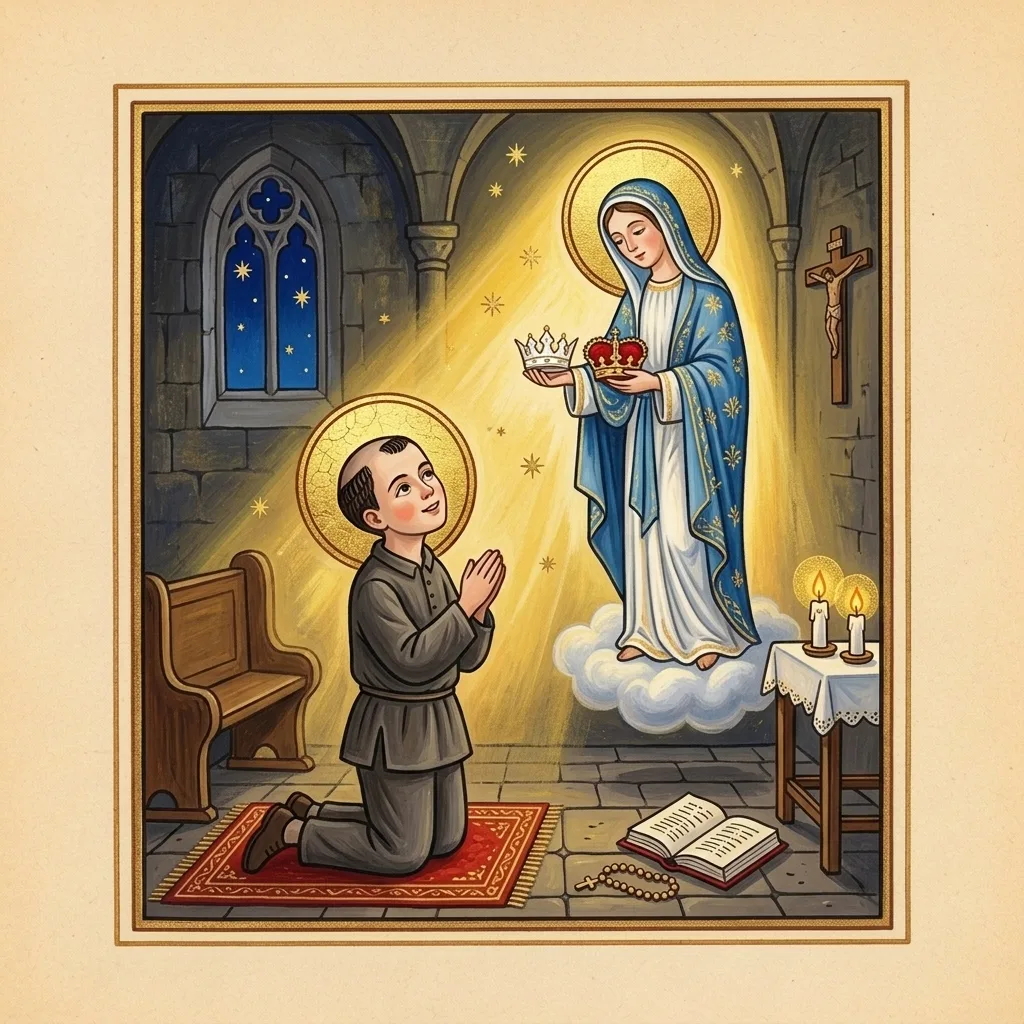
Virgin Mary offers him two crowns: white for purity, red for martyrdom. He accepts both.
Militia Immaculatae
While a student in Rome, he founds the Militia Immaculatae to fight the enemies of the Church through Mary's intercession.
City of the Immaculate
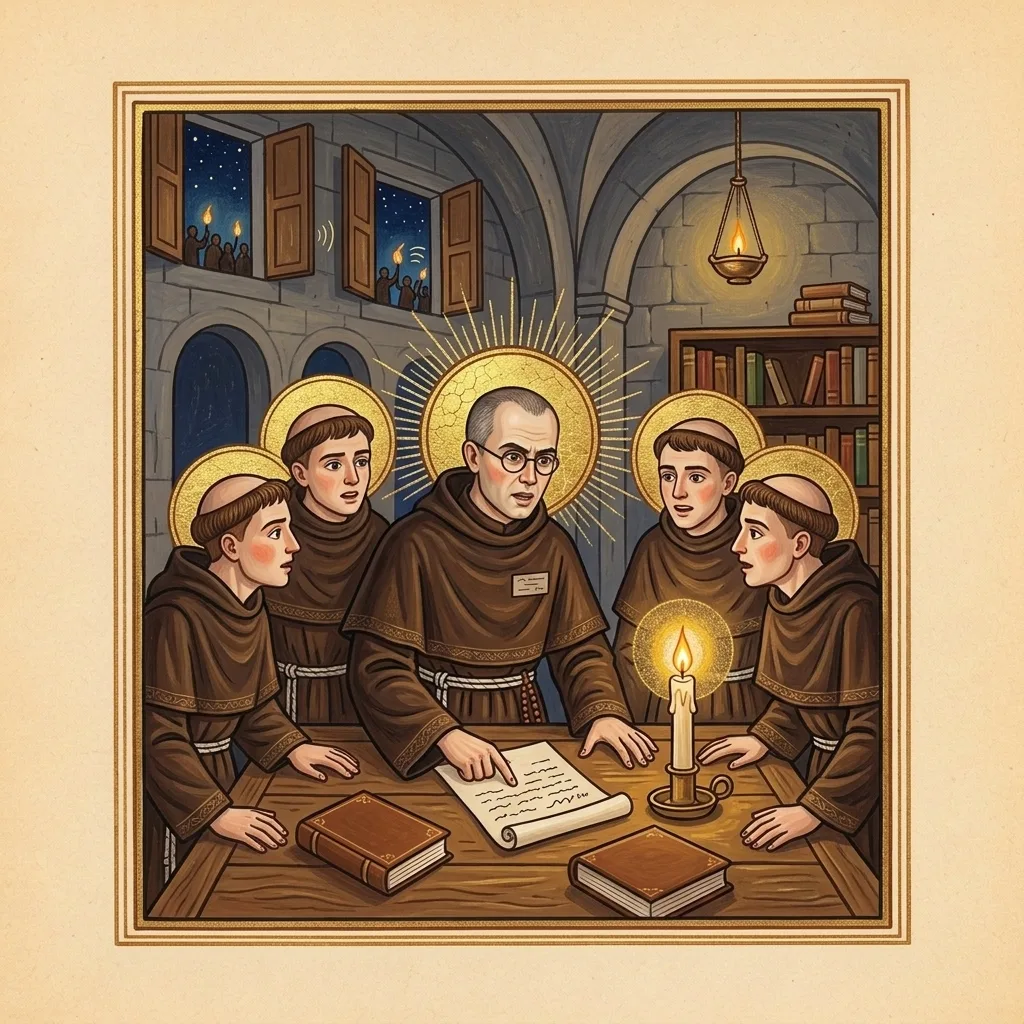
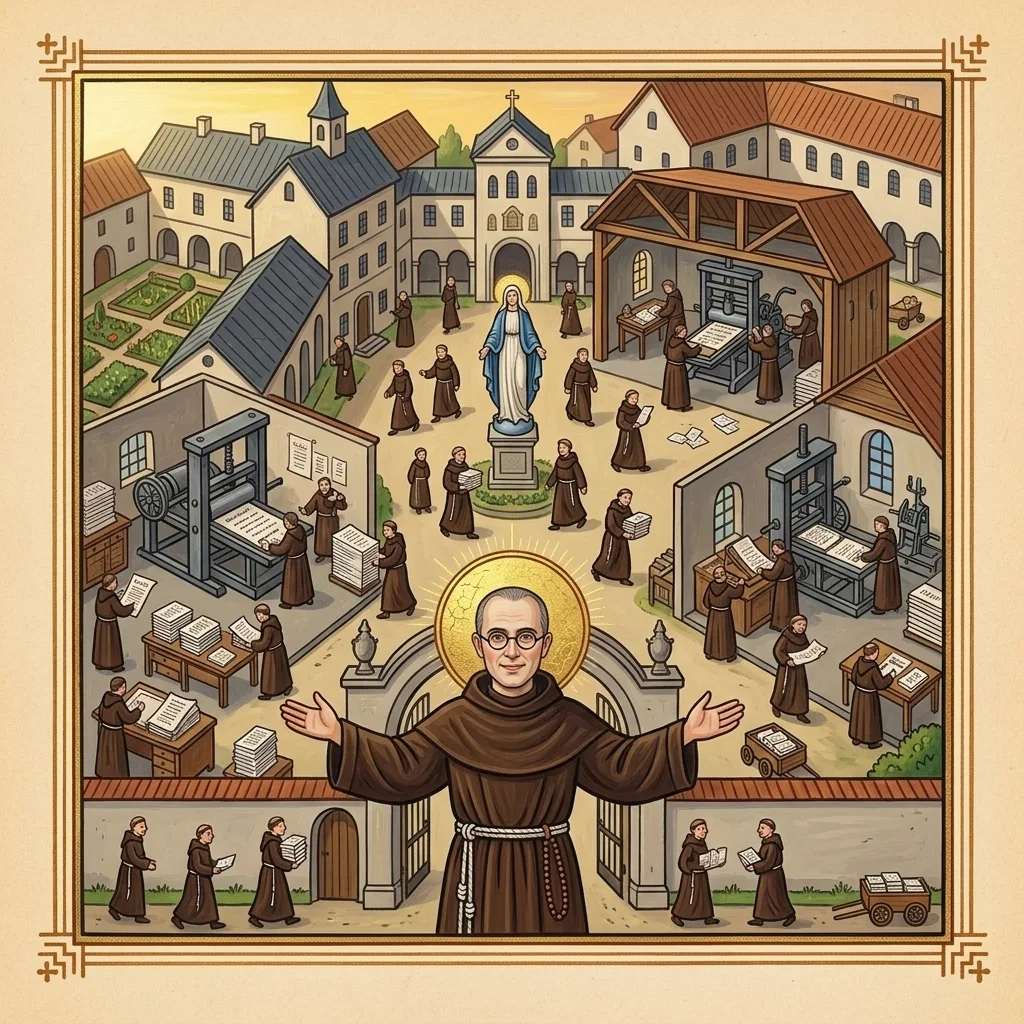
Founds Niepokalanów near Warsaw, which becomes the largest friary in the world.
Mission to Japan
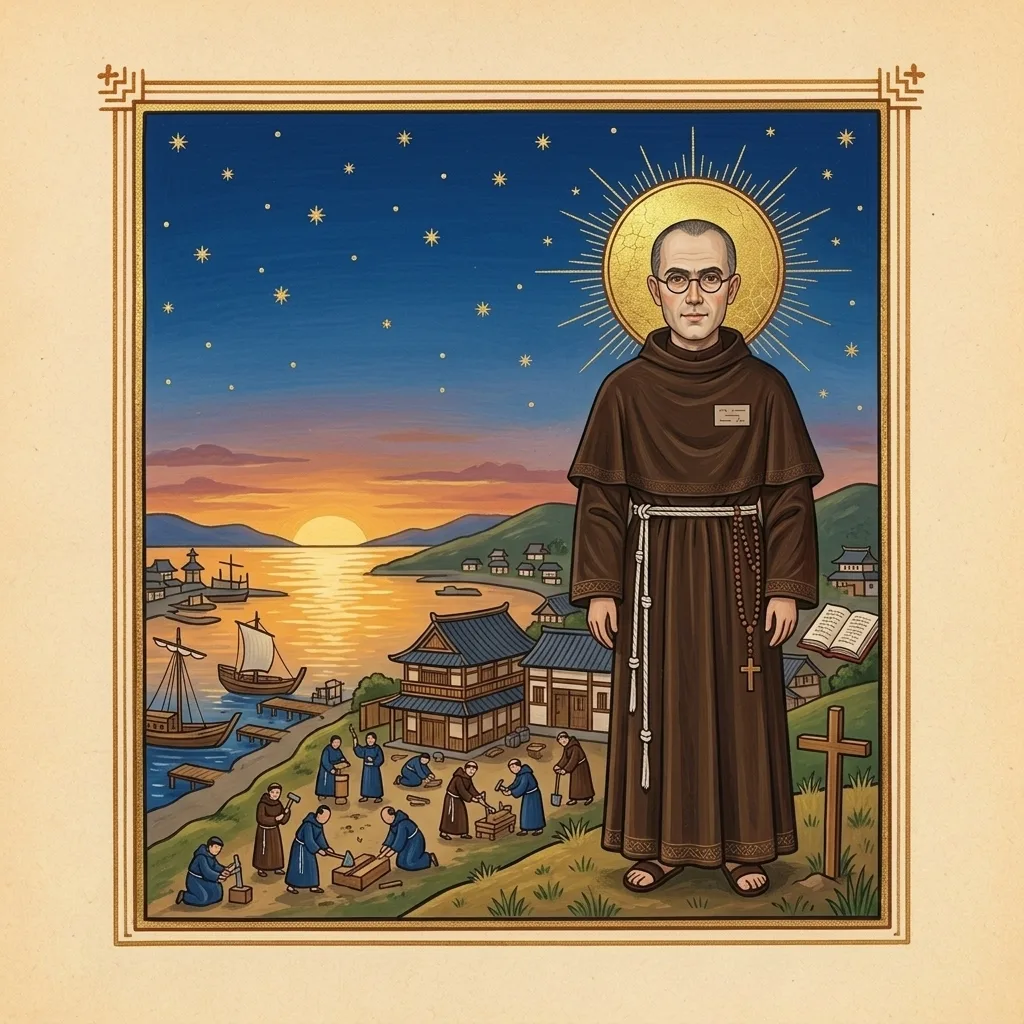
Travels to Nagasaki to establish a mission. The monastery miraculously survives the atomic bomb years later.
Arrest
Arrested by the Gestapo and eventually transferred to Auschwitz as prisoner #16670.
The Sacrifice
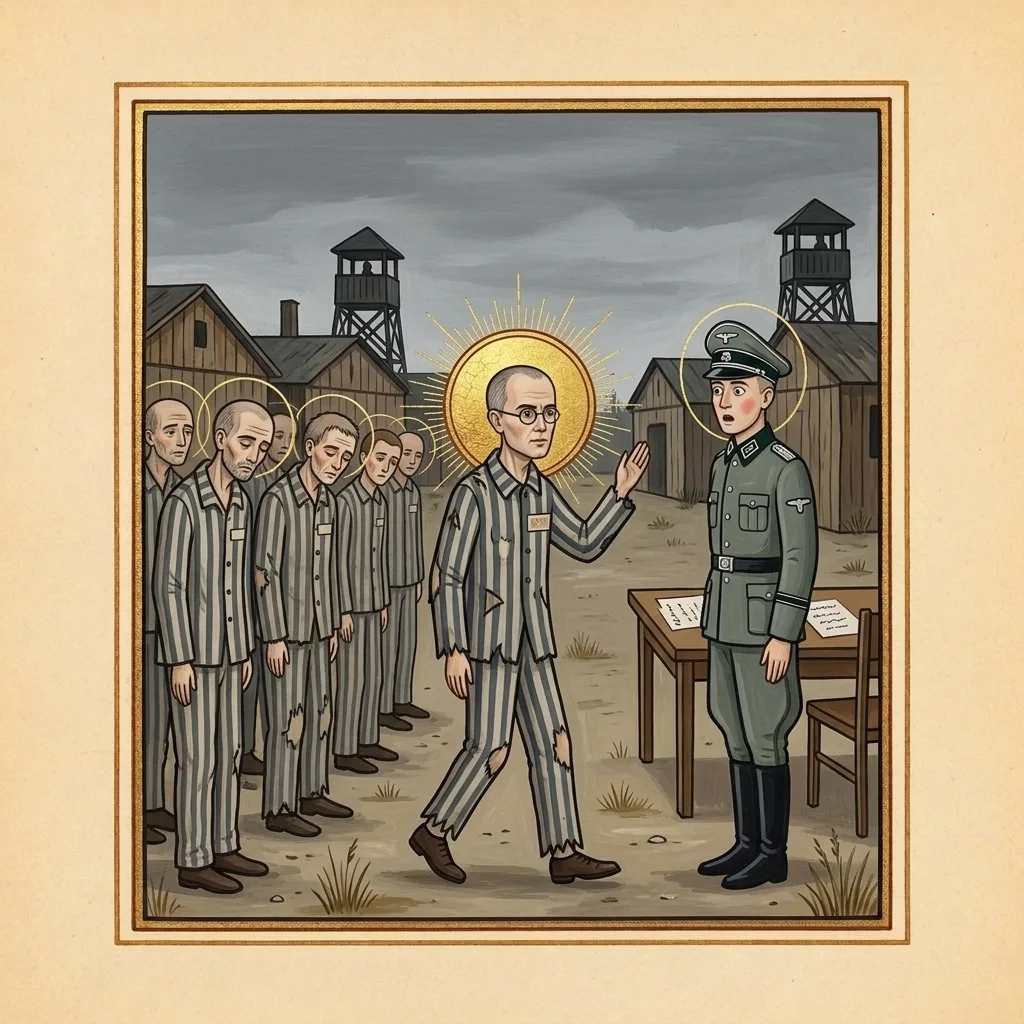
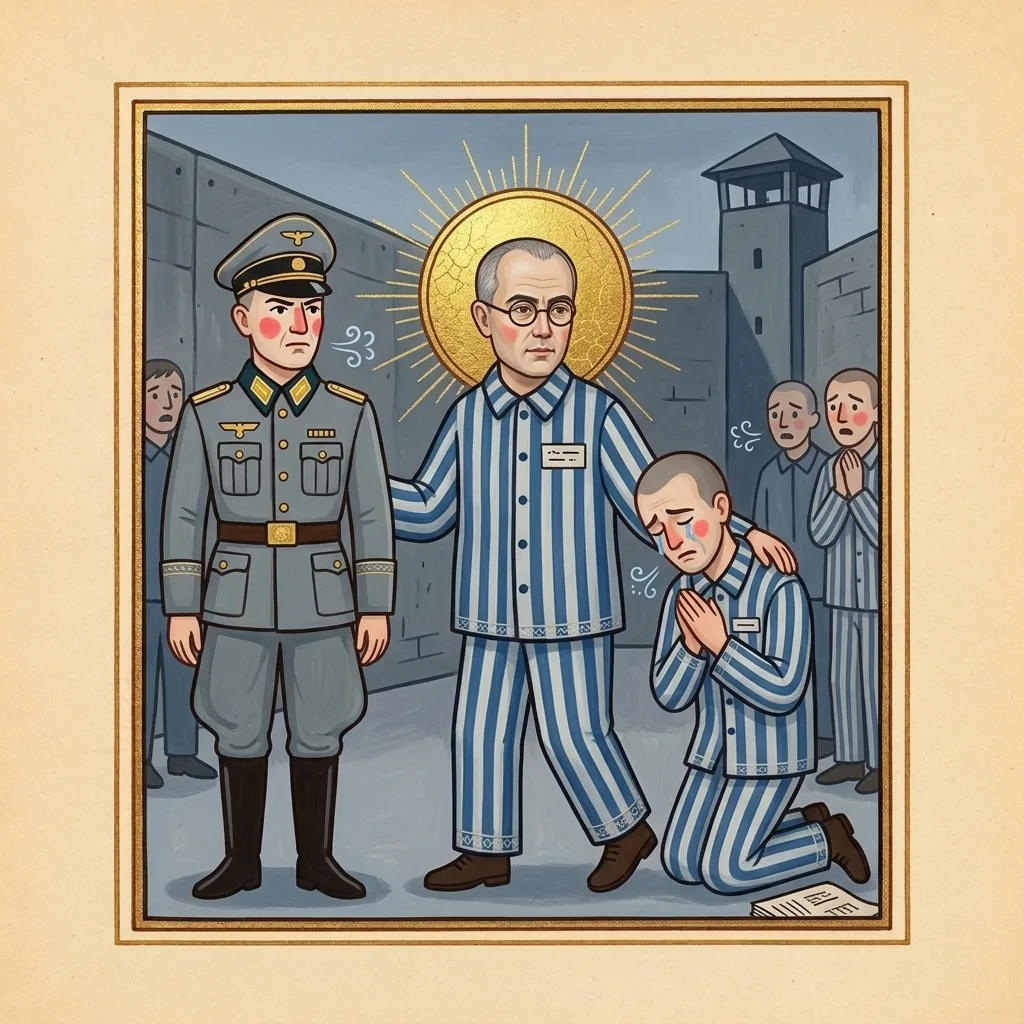
Late July. Steps forward to take the place of Franciszek Gajowniczek, a condemned father.
Martyrdom
August 14. After two weeks in the starvation bunker without water or food, he is killed with a carbolic acid injection.
Related Saints
Connections in the communion of saints
Francis of Assisi
Kolbe was a Conventual Franciscan whose self-sacrifice echoed Francis's radical love.
Óscar Romero
Both modern martyrs who gave their lives for others—Kolbe in Auschwitz, Romero for his people.
John Paul II
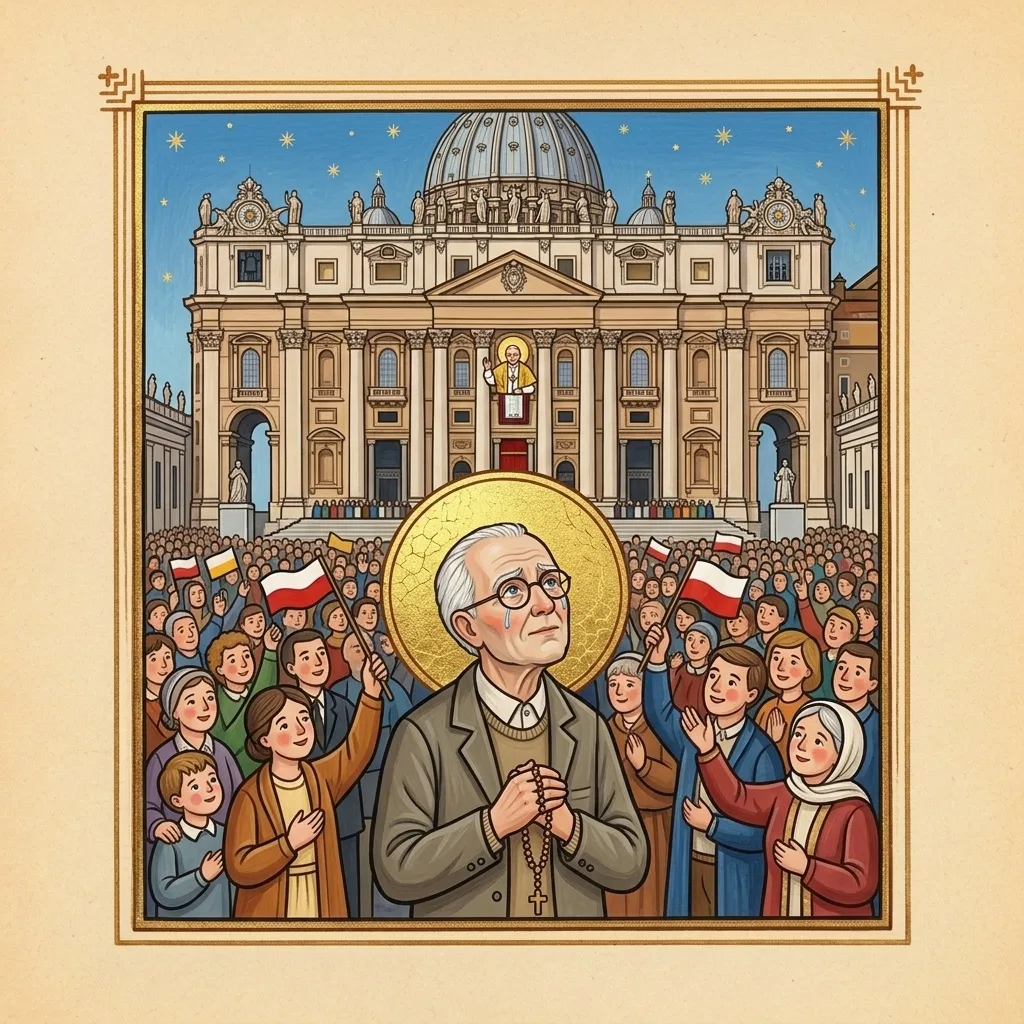
Fellow Polish saints. John Paul II canonized Kolbe in 1982, calling him a 'martyr of charity.'
Teresa of Calcutta
Both exemplified radical self-gift to the most vulnerable—Kolbe in Auschwitz, Teresa in Calcutta.
Charles Lwanga
Both modern martyrs who died protecting others—Charles for protecting fellow pages, Kolbe for a stranger.
Reflections & Commentary
3 perspectives on the life and teachings of Maximilian Kolbe

What Would You Do? Kolbe and the Impossible Choice
When a Saint Makes Heroism Look Simple and the Rest of Us Feel Inadequate
A priest volunteers to die in a stranger's place at Auschwitz. We're told it's inspiring. But honestly? It's terrifying. What do we do with saints who are so heroic they make ordinary goodness feel like failure?
Let me be honest: Maximilian Kolbe's story makes me deeply uncomfortable.
Not because it isn't inspiring—it absolutely is. Not because I don't admire what he did—I do, enormously.
But because when I imagine myself in that situation, standing in that line at Auschwitz, hearing Franciszek Gajowniczek cry out for his family—I'm not sure I'd step forward.
And that makes me feel like a moral failure.
This is the problem with extreme heroism: it sets a standard that's so high, most of us can't even imagine reaching it. And then we're left with a question: If I wouldn't die for a stranger, am I even a good person? If Kolbe's the standard for Christianity, where does that leave the rest of us?
Let's talk about it honestly. No pious platitudes. No easy answers. Just the uncomfortable gap between sainthood and ordinary life.
The Story We Tell
First, the facts: Maximilian Kolbe was a Polish Franciscan priest imprisoned at Auschwitz in 1941. When a prisoner escaped, the Nazis selected ten men to die by starvation as collective punishment.
One of the selected men, Franciszek Gajowniczek, cried out: "My wife! My children!"
Kolbe stepped forward: "I am a Catholic priest. I wish to take his place. I am old; he has a wife and children."
The Nazi officer shrugged and said okay.
Kolbe went to the starvation bunker. Two weeks later, still alive, he was killed with a lethal injection. Gajowniczek survived the war, lived another 54 years, and spent the rest of his life telling Kolbe's story.
The end.
Except that's not the end. Because then we have to ask: What the hell do we do with this?
The Inspiration Problem
Religious people love this story. It's preached in homilies. Taught in schools. Held up as the ultimate example of Christian love: "Greater love has no one than this, that someone lay down his life for his friends."
And it is inspiring. I'm not denying that.
But here's the thing about inspiration: it can become a weapon. When heroism is presented as the standard—the thing "real Christians" do—everyone who isn't heroic feels like a failure.
I've felt this my whole life with saints' stories. They're always doing impossible things:
- Francis gives away all his money and lives with lepers
- Teresa of Calcutta picks up dying people from the streets
- Joan of Arc leads armies at 17
- Kolbe dies for a stranger
Meanwhile, I'm over here struggling to:
- Not snap at my partner when I'm tired
- Give money to homeless people without feeling resentful
- Show up consistently for friends when they're going through hard times
- Not doomscroll when I should be working
You see the gap?
Saints make heroic virtue look easy. And when we can't replicate it, we either:
- Give up entirely ("I'll never be that good, so why try?")
- Beat ourselves up ("I'm a terrible person")
- Dismiss the saint ("That's unrealistic/unhealthy/performative")
None of these responses are helpful.
The Context We Ignore
Here's what I think we miss when we tell Kolbe's story as simple inspiration: context.
Kolbe didn't wake up one random Tuesday morning and decide to be a hero. He'd been preparing his whole life:
He was a religious. He'd taken vows of poverty, chastity, and obedience. He'd literally signed up for a life of self-denial and service. That's not nothing.
He was already dying. Auschwitz was a death camp. Everyone there was on borrowed time. Kolbe had been beaten, starved, worked to exhaustion. He was 47 but looked ancient. He wasn't choosing death over a comfortable life. He was choosing how to die.
He'd been practicing self-sacrifice. Witnesses said Kolbe gave away his food rations, helped others, heard confessions, prayed constantly. The starvation bunker wasn't a sudden burst of heroism—it was the culmination of a pattern.
He had a specific framework. Kolbe's entire spirituality was built around "total consecration to Mary" and imitating Christ's sacrifice. When the moment came, he had a theological narrative to act within.
Context doesn't diminish what Kolbe did. But it does make it less mysterious. He wasn't a random guy who spontaneously became a superhero. He was someone who'd been training for this his whole life—and the training kicked in when it mattered.
Would You Step Forward?
Okay, the uncomfortable question: Would you?
Be honest. Imagine:
You're in a concentration camp. You're starving. You're exhausted. You've watched people die every day. You know the Nazis might kill you for any reason, any time.
Ten men are selected to die by starvation. One of them cries out. He has a family.
Do you step forward?
I want to say I would. I really do. But honestly?
I don't know.
And I think most people, if they're honest, don't know either.
We like to imagine we're the hero in every story. But research on human behavior in crisis situations shows most people:
- Freeze
- Follow the crowd
- Prioritize their own survival
- Experience moral injury afterward
There's no shame in this. It's biology. It's self-preservation. It's human.
But it creates a terrible tension: We admire Kolbe. We want to be like Kolbe. But we suspect we wouldn't be like Kolbe.
So what do we do with that?
The Danger of Hero Worship
Here's where I push back on traditional saint veneration: I think hero worship can be toxic.
When we make saints into superhuman figures—people who did things we could never do—we create a two-tier Christianity:
- Real saints (the heroes)
- Everyone else (the failures)
And this lets us off the hook. "Well, I'm not a saint, so I guess radical self-giving love isn't for me."
But that's not what the Gospel says. Jesus told everyone—not just future canonized saints—to love their enemies, pray for persecutors, give to those who ask, go the extra mile.
The Sermon on the Mount isn't "suggestions for extraordinary people." It's marching orders for all disciples.
So we can't use Kolbe's extremity as an excuse for mediocrity. "I wouldn't die for a stranger, therefore I don't have to be inconvenienced for a stranger."
That's a cop-out.
The Spectrum of Sacrifice
Maybe the solution is to think of sacrifice on a spectrum rather than as an all-or-nothing proposition.
At one extreme: Kolbe, volunteering for death.
At the other extreme: Basic decency—don't lie, cheat, steal, murder.
And in between: A whole range of sacrificial actions that most of us can actually do:
Low-level sacrifice:
- Letting someone merge in traffic
- Giving up your seat on the bus
- Not correcting someone when they're wrong and it doesn't matter
- Listening to someone when you'd rather be on your phone
Medium-level sacrifice:
- Regular financial giving that actually affects your budget
- Showing up for people even when it's inconvenient
- Forgiving someone who hurt you
- Changing your plans to meet someone else's need
High-level sacrifice:
- Long-term caregiving for a sick family member
- Fostering/adopting kids with trauma
- Dedicating your career to low-paid service work
- Staying in a difficult situation for the sake of others
Extreme sacrifice:
- Jumping on a grenade to save others
- Donating a kidney to a stranger
- Kolbe-level substitutionary death
Most of us won't be asked for extreme sacrifice. But we're asked daily for low- and medium-level sacrifices.
And here's the thing: If we're not practicing the small sacrifices, we definitely won't be ready for the big ones.
Kolbe stepped forward at Auschwitz because he'd been stepping forward his whole life—in small ways, in medium ways, in incrementally larger ways.
Franciszek Gajowniczek's Burden
Can we talk about the guy who lived?
Franciszek Gajowniczek survived Auschwitz. He came home to Poland. He discovered his sons—the ones he cried out for—had been killed by the Soviets in 1940. He didn't know that when Kolbe took his place.
So Kolbe died to save a man whose sons were already dead.
Does that change the story? Make it less heroic?
I don't think so. Kolbe couldn't have known. He responded to what he saw: a man with a family. The fact that the family was partially gone doesn't diminish the love.
But here's what gets me: Gajowniczek had to live with that.
Every morning for 54 years, he woke up knowing someone died so he could live. How do you carry that? What do you do with that gift?
Gajowniczek's response: He told the story. Everywhere. To anyone who'd listen. He made Kolbe's sacrifice matter by witnessing to it.
But I imagine there were also days when the weight was crushing. Days when he thought: "Why me? Why did I deserve to live when Kolbe died?"
Survivor's guilt is real. And it's brutal. And Gajowniczek carried it for half a century.
This is the shadow side of heroic sacrifice: someone has to live with being saved.
What This Means for Ordinary People
So where does this leave us—those of us who aren't heroic, who aren't sure we'd step forward, who struggle with small sacrifices let alone large ones?
I think it means a few things:
1. Don't use Kolbe as an excuse for mediocrity. "I'm not a saint, so I don't have to try." No. The fact that you wouldn't die for a stranger doesn't mean you can't inconvenience yourself for one.
2. Practice small sacrifices. You probably won't be asked to die heroically. But you'll be asked daily to give up comfort, preferences, convenience. Say yes to those asks. That's training.
3. Be honest about your limits. It's okay to not be Kolbe. It's okay to admit you're scared, selfish, limited. God works with who you are, not who you wish you were.
4. Focus on the person in front of you. Kolbe didn't save the world. He saved one man. You don't have to solve systemic problems. Just love the specific person in front of you today.
5. Recognize that heroism is cumulative. Kolbe's final act was the sum of thousands of small acts. Your small acts matter. They're building something, even if you never see the result.
The Question of Moral Luck
Here's something that bothers me: Kolbe is a saint partly because he happened to be at Auschwitz when this specific situation arose.
If he'd never been arrested, he'd just be "Father Maximilian Kolbe, publisher of Catholic magazines." Good guy. Devout. But not a canonized saint.
He became a saint because circumstances gave him the opportunity for heroic sacrifice.
Philosophers call this "moral luck"—the idea that our moral status depends partly on factors outside our control.
Two people could have identical character. One happens to be in a situation requiring heroism; the other never is. The first becomes a hero. The second lives and dies unknown.
Is that fair? Is sanctity partly a matter of luck—being in the right (or wrong) place at the right time?
I don't have an answer. But it makes me think: Maybe the point isn't to become a canonized saint. Maybe the point is to be the kind of person who would act heroically if the situation arose.
And you prove that by how you act in the situations you do face.
The Unbearable Weight of "What Would Jesus Do?"
Christians love to ask: "What would Jesus do?"
With Kolbe, the answer is clear: Jesus would (and did) take our place. Jesus would (and did) die so others could live.
So if we're supposed to imitate Christ, we're supposed to be like Kolbe.
But this is where WWJD becomes crushing. Because Jesus is God. He's literally perfect. And we're not.
Asking "What would Kolbe do?" is slightly better because at least Kolbe was human. But he was still a saint—someone with extraordinary grace, faith, and courage.
Maybe a better question is: "What would Jesus ask me to do, given who I actually am, with the resources I actually have, in the situation I'm actually in?"
Not "What would the ideal version of me do?" But "What's the next right thing for actual me?"
That's more manageable. And more honest.
Stories We Need
Here's what I wish we talked about more: Saints who struggled.
Not just "they struggled and then triumphed." But saints who struggled and sometimes failed. Who had doubts. Who screwed up. Who were inconsistent.
Because that's most of us. We're not consistently heroic. We're erratically decent with occasional moments of real goodness.
I want to hear about:
- The time Peter denied Jesus three times
- Augustine's years of sexual struggle before conversion
- Teresa of Ávila's decades of dry prayer
- Thérèse of Lisieux's doubts about heaven on her deathbed
Not to diminish them. But to humanize them. To show that sanctity isn't perfection. It's getting back up every time you fall.
Kolbe's story is powerful. But it can also be paralyzing if we don't also hear stories of people who:
- Didn't step forward but wish they had
- Tried to be heroic and failed
- Lived ordinary lives of quiet faithfulness
- Struggled and doubted and questioned and kept going anyway
The Last Word
I don't know if I'd step forward like Kolbe did.
I hope I would. I pray I would. But I honestly don't know.
What I do know is this: I can step forward today.
I can give money to the person asking on the street corner. I can show up for my friend who's struggling. I can apologize when I'm wrong. I can listen instead of talking. I can choose the other person's good over my own comfort.
These aren't Auschwitz-level sacrifices. But they're something. And if I do them consistently, maybe—just maybe—I'll build the kind of character that would step forward if the extreme situation ever comes.
Or maybe I won't. Maybe I'd freeze. Maybe I'd stay silent. Maybe I'd survive with crushing guilt like Gajowniczek.
But that possibility doesn't excuse me from the small sacrifices I can make today.
Kolbe didn't know, when he was sharing his soup ration with another prisoner, that he was training for the starvation bunker. He just knew: this person is hungry, and I can help.
That's all any of us can do. See the person in front of us. Recognize their need. And respond with whatever love we can manage.
Sometimes that'll be heroic. Usually it'll be ordinary. Always it'll be imperfect.
But it's something.
And maybe something is enough.
A Prayer for Those Who Aren't Heroes
God,
I'm not Maximilian Kolbe. I'm not heroic. I'm not even sure I'm good.
But I want to be the kind of person who steps forward when it matters.
So train me in the small things: The inconvenient kindness. The uncomfortable truth. The expensive generosity. The persistent forgiveness.
Let me practice sacrifice in ways I can manage, so that if the big moment comes, I'll be ready.
And if I'm never asked for extreme heroism, let my ordinary faithfulness be enough.
Through Christ, who knows what it's like to be both divine and human, both perfect and limited, both heroic and ordinary.
Amen.