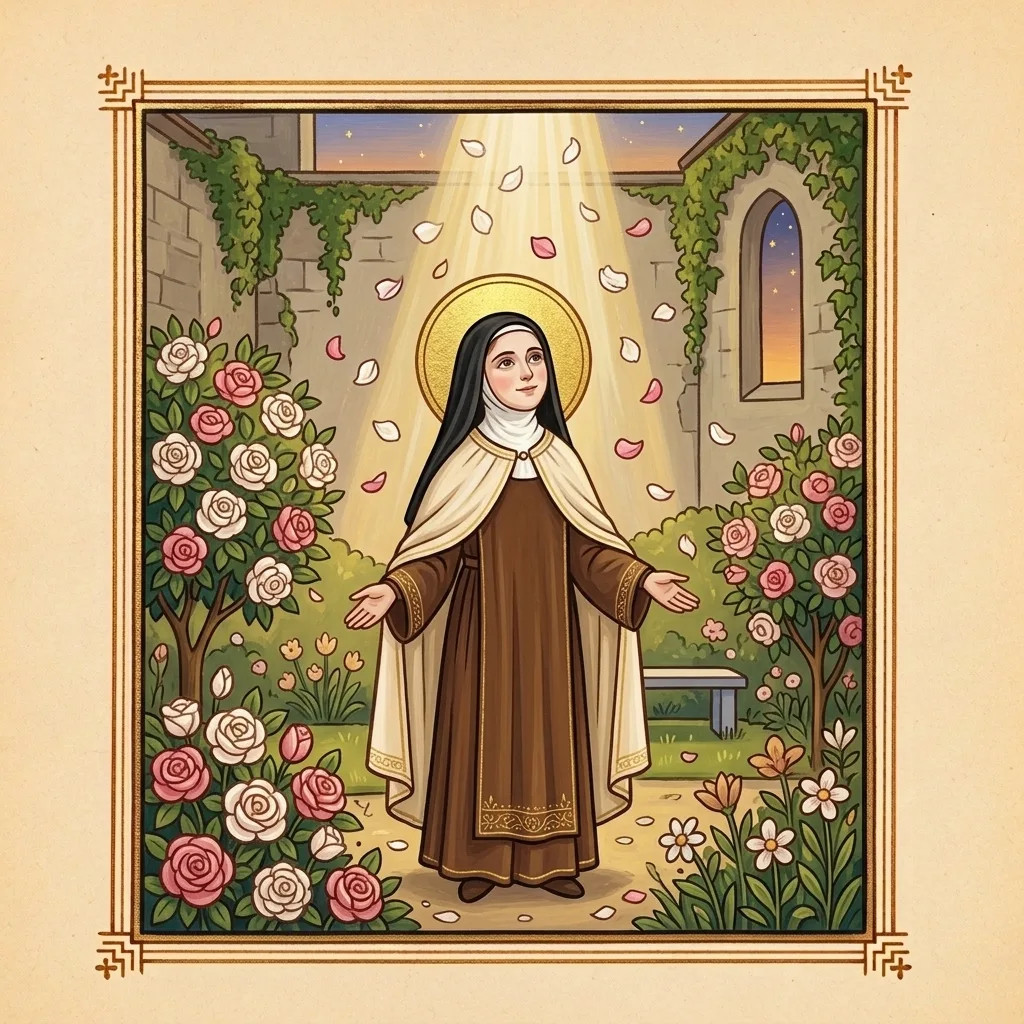
Saint Library
October 1modernRoman

Thérèse of Lisieux

Doctor

Sanctified Life

18731897

Also Known As

Little Flower

Patronage

missions

"I will spend my heaven doing good on earth."

The 'Little Flower' who proved that holiness is found in ordinary tasks done with extraordinary love. Entering the Carmel of Lisieux at age 15, she lived a hidden life of prayer and service. She discovered her 'Little Way' of spiritual childhood—trusting God completely like a small child. Though she died obscurely at 24 of tuberculosis, her autobiography 'Story of a Soul' became a global sensation, making her one of the most popular saints in history and a Doctor of the Church.

Thérèse of Lisieux
Historical Legacy

Historical Journey

Life Locations

Historical Context
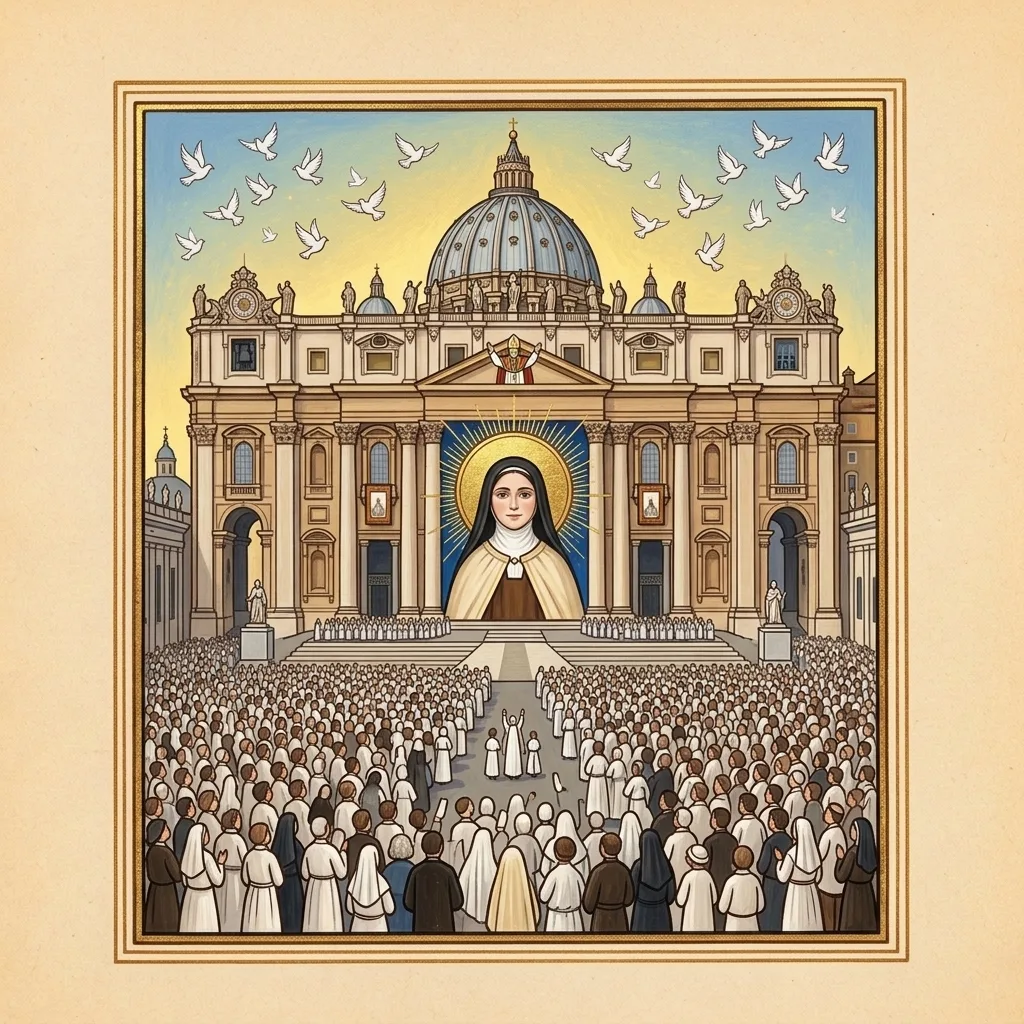
Thérèse of Lisieux (1873–1897), born Marie Françoise-Thérèse Martin, was a French Discalced Carmelite nun who died at twenty-four yet became one of the most popular and influential saints in the history of the Church. Pope Pius X called her 'the greatest saint of modern times,' and her spiritual autobiography, 'Story of a Soul,' has been translated into more than sixty languages. Born in Alençon, Normandy, to a devout middle-class family (both her parents, Louis and Zélie Martin, have themselves been canonized — the first married couple in modern history to be declared saints together), Thérèse experienced the death of her mother at age four and grew up a sensitive, emotionally intense child prone to tears and scruples. At age fourteen, she felt a profound Christmas grace that she described as her 'complete conversion,' freeing her from excessive sentimentality. Thérèse entered the Carmelite convent of Lisieux at the exceptionally young age of fifteen, after personally appealing to Pope Leo XIII during a pilgrimage to Rome. Within the convent, she lived an outwardly unremarkable life — no visible mystical phenomena, no great ascetical feats, no positions of leadership. Yet it was precisely this ordinariness that became the vehicle for her revolutionary spiritual insight. Thérèse developed what she called her 'Little Way' — a spirituality centered on doing small, everyday acts with great love and confidence in God's mercy, rather than seeking extraordinary penances or experiences. She described herself as a 'little flower' in God's garden, recognizing that not everyone is called to be a rose but that even the smallest wildflower gives glory to God. This teaching democratized holiness, making it accessible to anyone regardless of temperament, talent, or circumstances. During her final eighteen months, Thérèse endured both tuberculosis and a profound trial of faith, experiencing temptations against belief itself — a spiritual darkness that she described as being seated 'at the table of sinners.' She bore this suffering in silence, maintaining her trust in love. Her autobiography, written under obedience, was published after her death and sparked a worldwide devotion. She was canonized in 1925 and declared a Doctor of the Church by Pope John Paul II in 1997 — the youngest Doctor and only the third woman to hold the title.
Canonization: canonized saint
Learn More on Wikipedia

Historical Depiction

Historical depiction of Thérèse of Lisieux

Wikimedia Commons Source

Titles & Roles

master of novicesmissionaryplaywrighttheologian

Writings

book

Story of a Soul

The spiritual autobiography detailing her 'Little Way' of trust and love.

Read More

Prayers

Sacred invocations and spiritual gems from the heart of Thérèse of Lisieux.

"Her daily prayer offering all trials and joys to God."

O my God! I offer Thee all my actions of this day for the intentions and for the glory of the Sacred Heart of Jesus. I desire to sanctify every beat of my heart, my every thought, my simplest works, by uniting them to His infinite merits; and I wish to make reparation for my sins by casting them into the furnace of His Merciful Love.

O my God! I ask for myself and for those whom I hold dear, the grace to fulfill perfectly Thy Holy Will, to accept for love of Thee the joys and sorrows of this passing life, so that we may one day be united together in heaven for all Eternity. Amen.

Gallery

Maison natale de Sainte Thérèse, maison de Louis et Zélie Martin
1 / 10

Maison natale de Sainte Thérèse, maison de Louis et Zélie Martin

Pierre-Yves Emile • 2009-06-25 16:47:51

CC BY-SA 3.0

Rue Saint-Blaise's house at Alençon: The family home and Therese's birthplace

Sacred Symbols

roses

Grace

Life Journey

1873

Born in Alençon

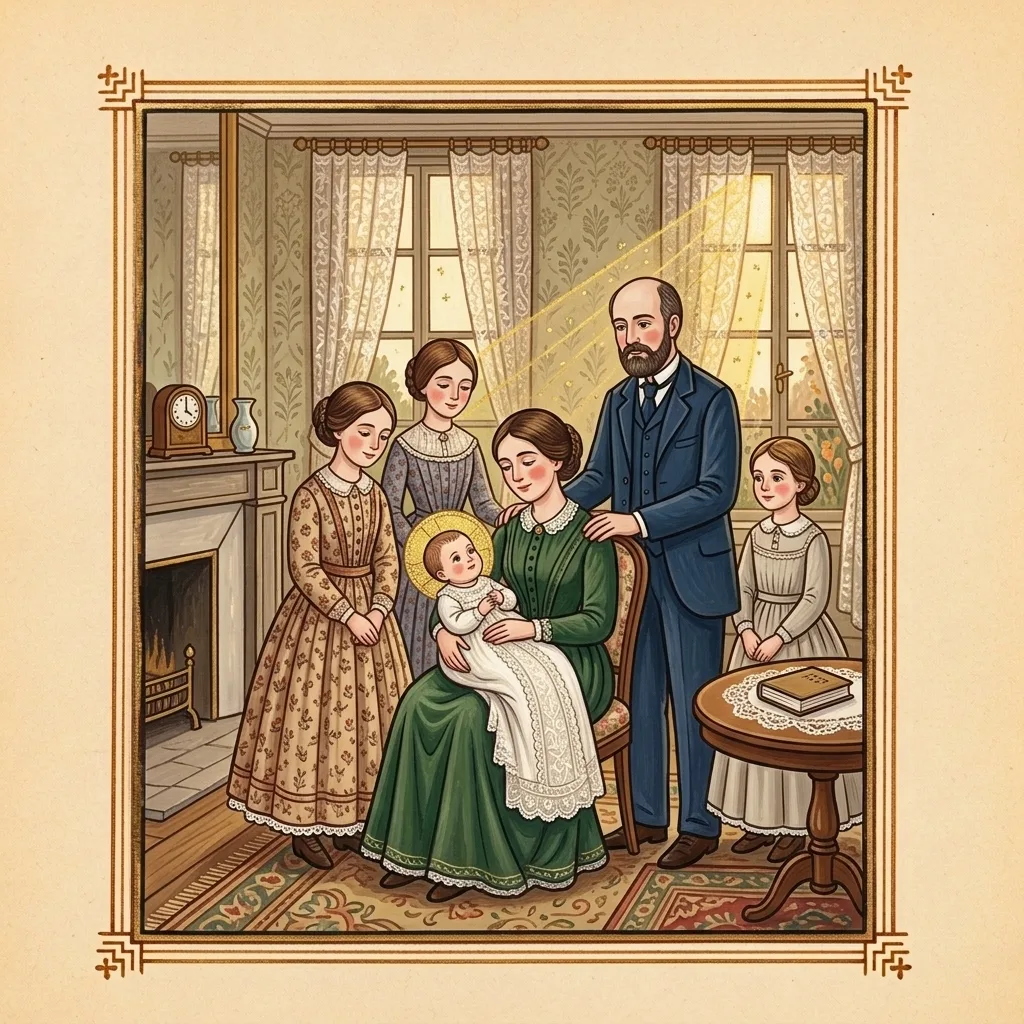
Born to Louis and Zélie Martin (who would later become the first married couple canonized together).

1877

Mother's Death

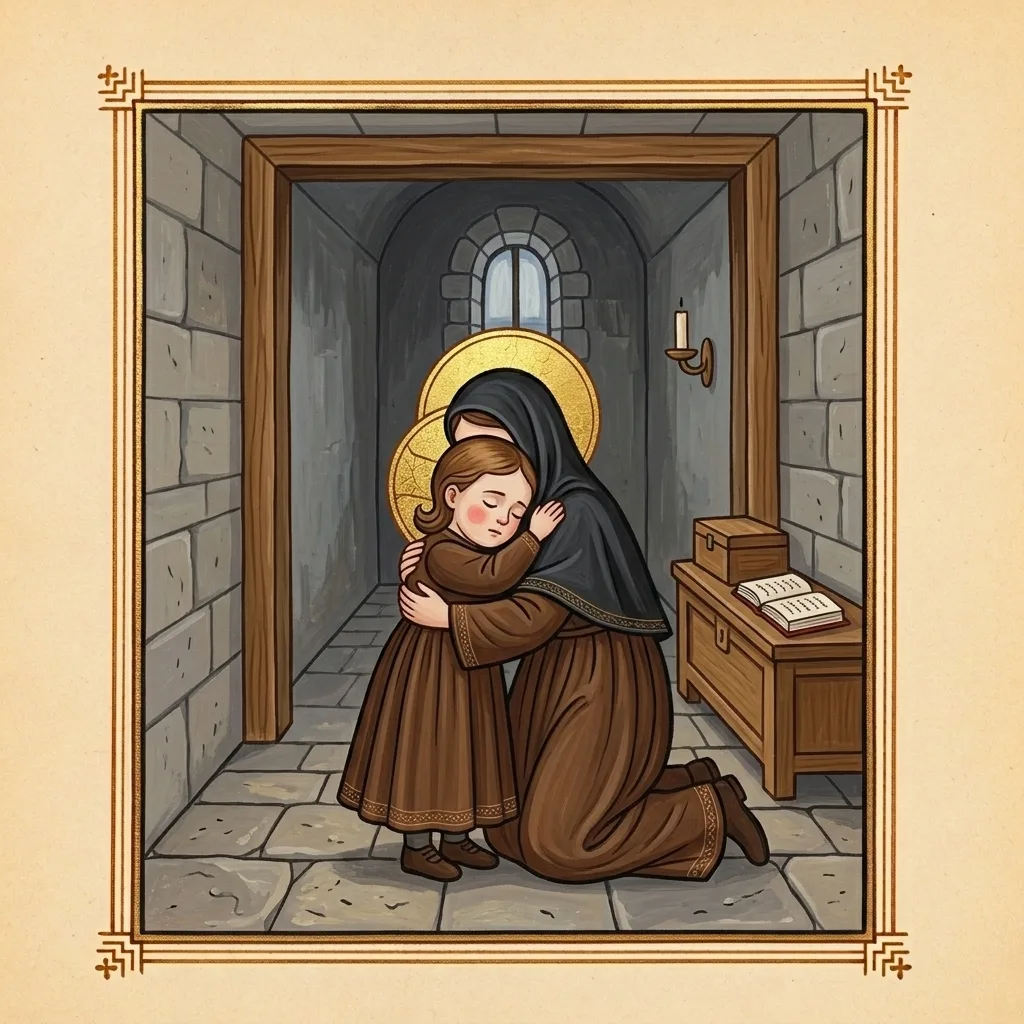
Her mother dies of breast cancer. The family moves to Lisieux. Thérèse becomes hypersensitive and easily tearful.

1883

The Smile of the Virgin

She is healed from a strange illness after seeing the statue of Mary smile at her.

1886

Christmas Conversion

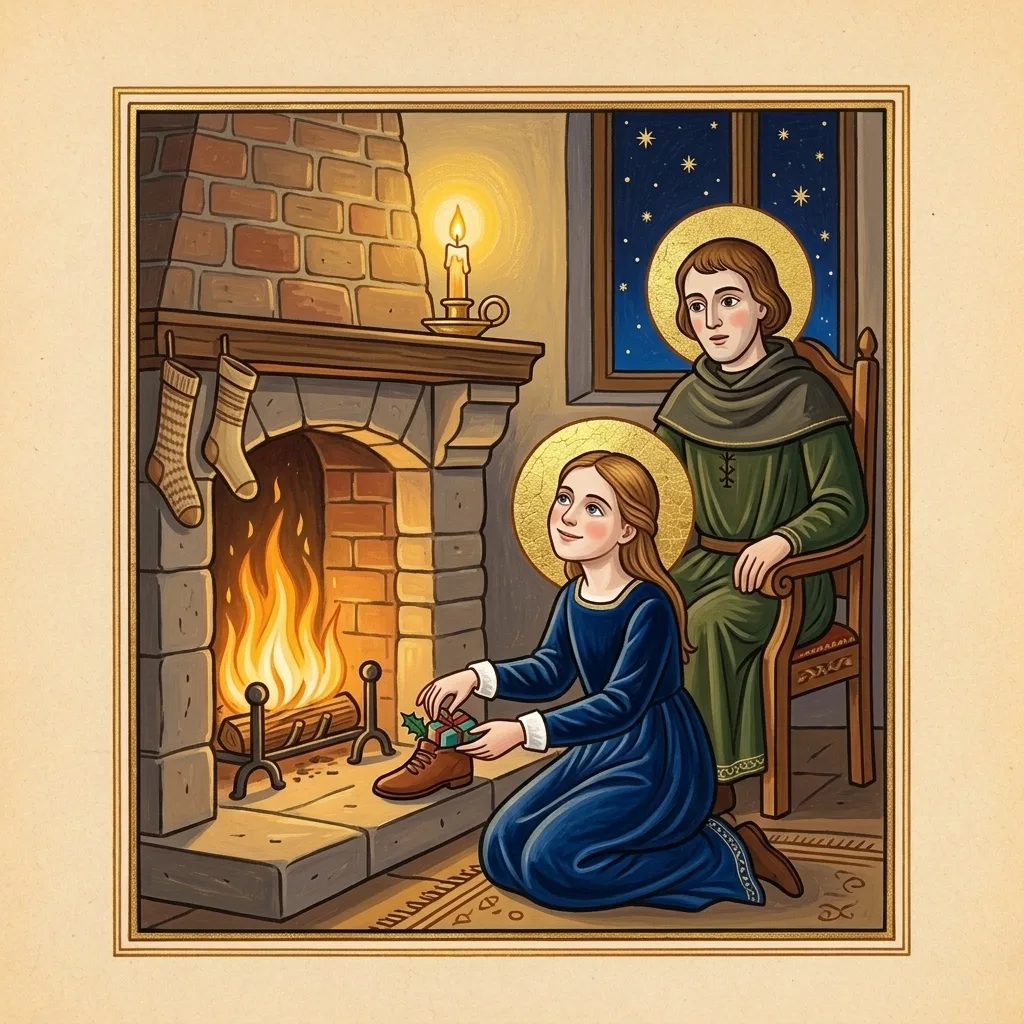
On Christmas Eve, she overhears her father's complaint but represses her tears, regaining her strength of character. She calls it her 'night of conversion'.

1887

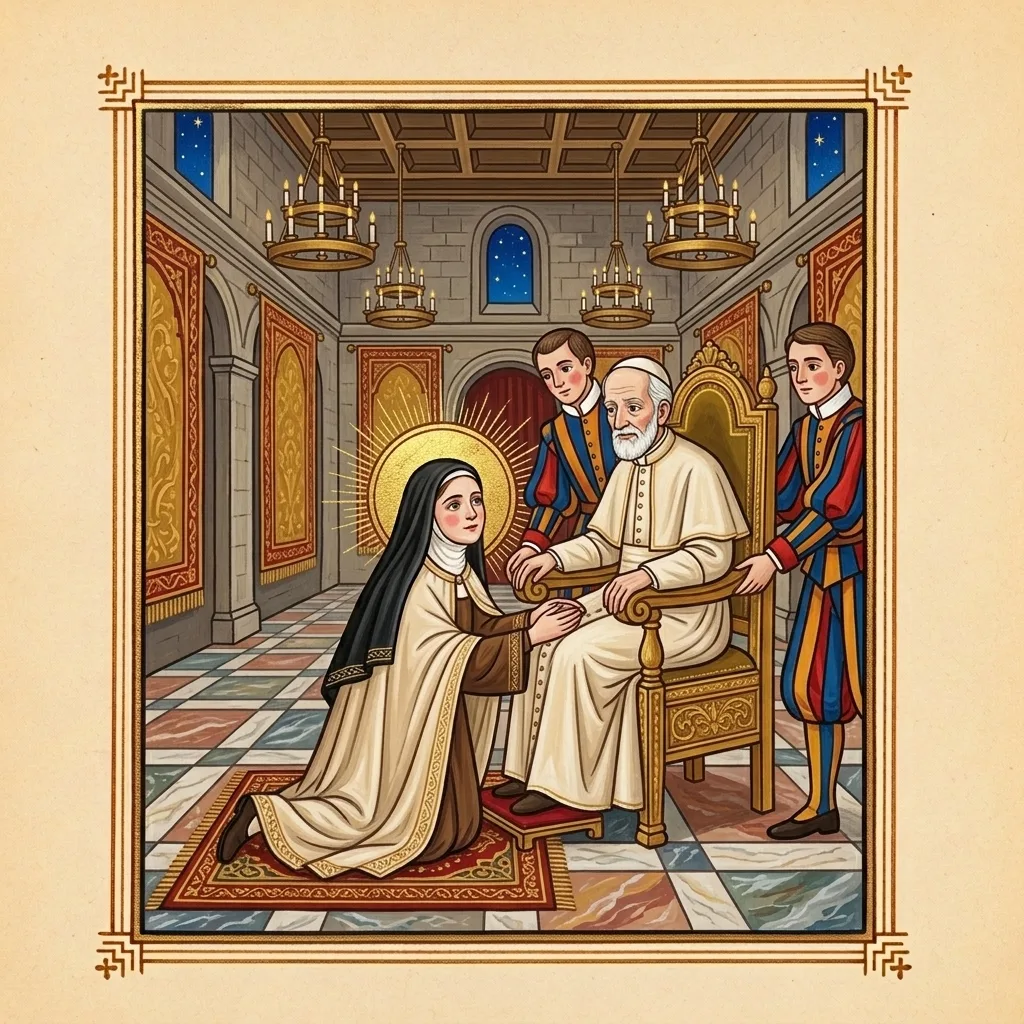
Audience with Leo XIII

On a pilgrimage to Rome, she breaks protocol and begs the Pope for permission to enter Camel at 15. The guards have to drag her away.

1888

Entrance to Carmel

She enters the strict cloistered convent, taking the name Thérèse of the Child Jesus and the Holy Face.

1896

First Hemoptysis

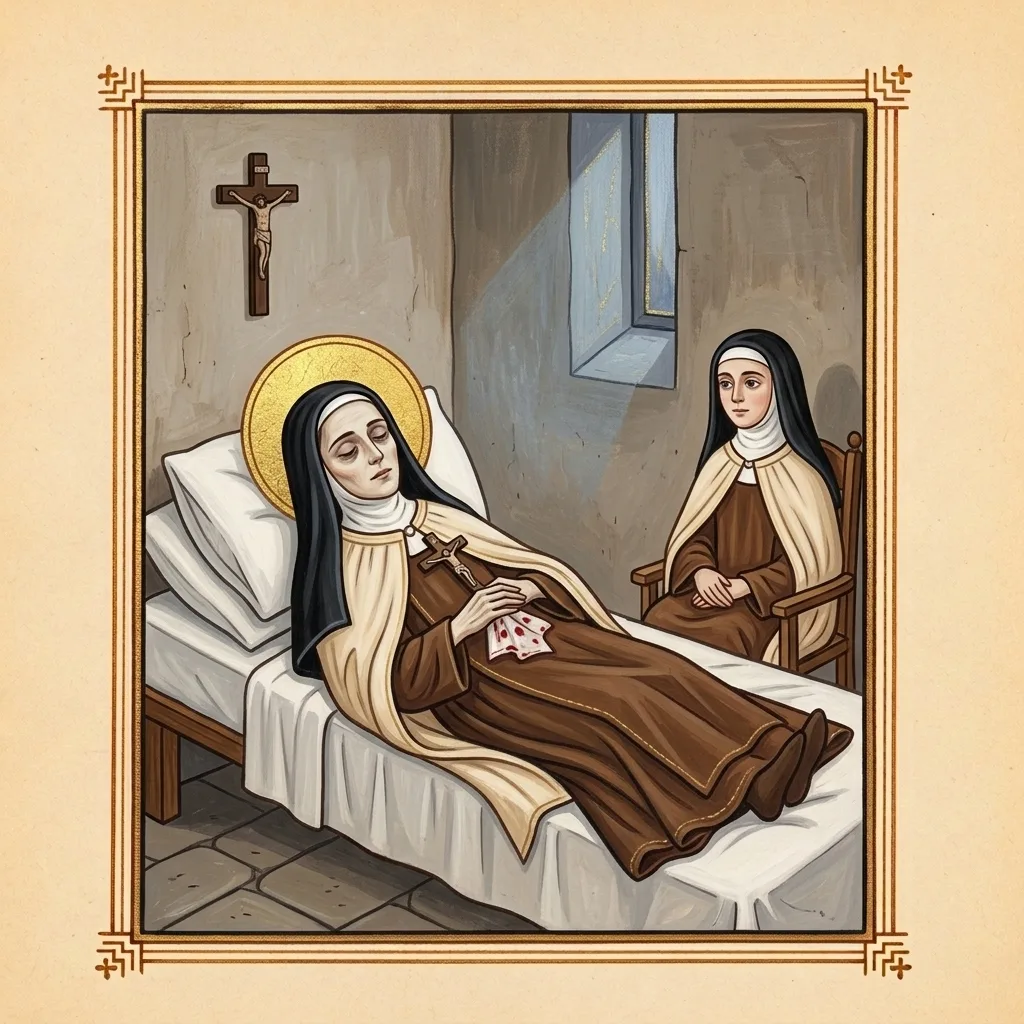
On Good Friday, she coughs up blood, the first sign of tuberculosis. She enters a 'dark night of faith' where heaven feels empty.

1897

Death

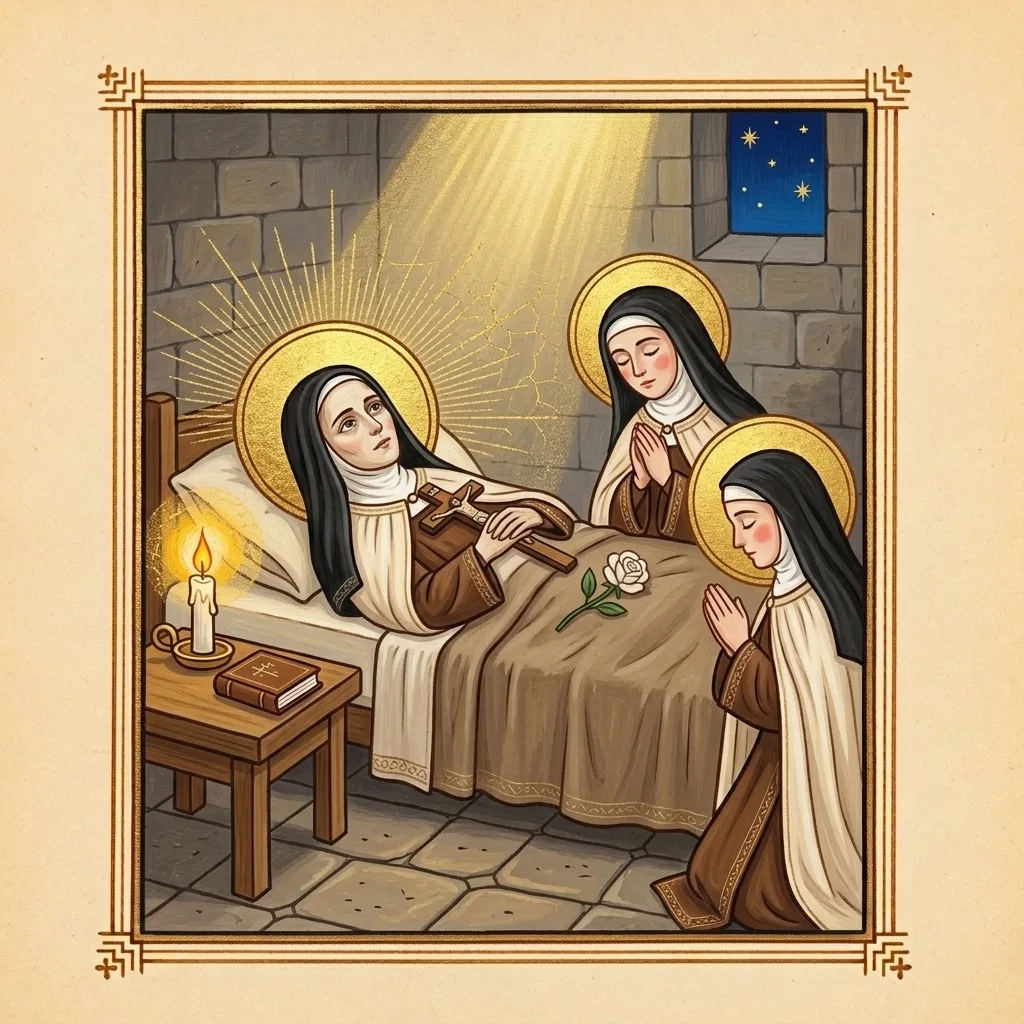
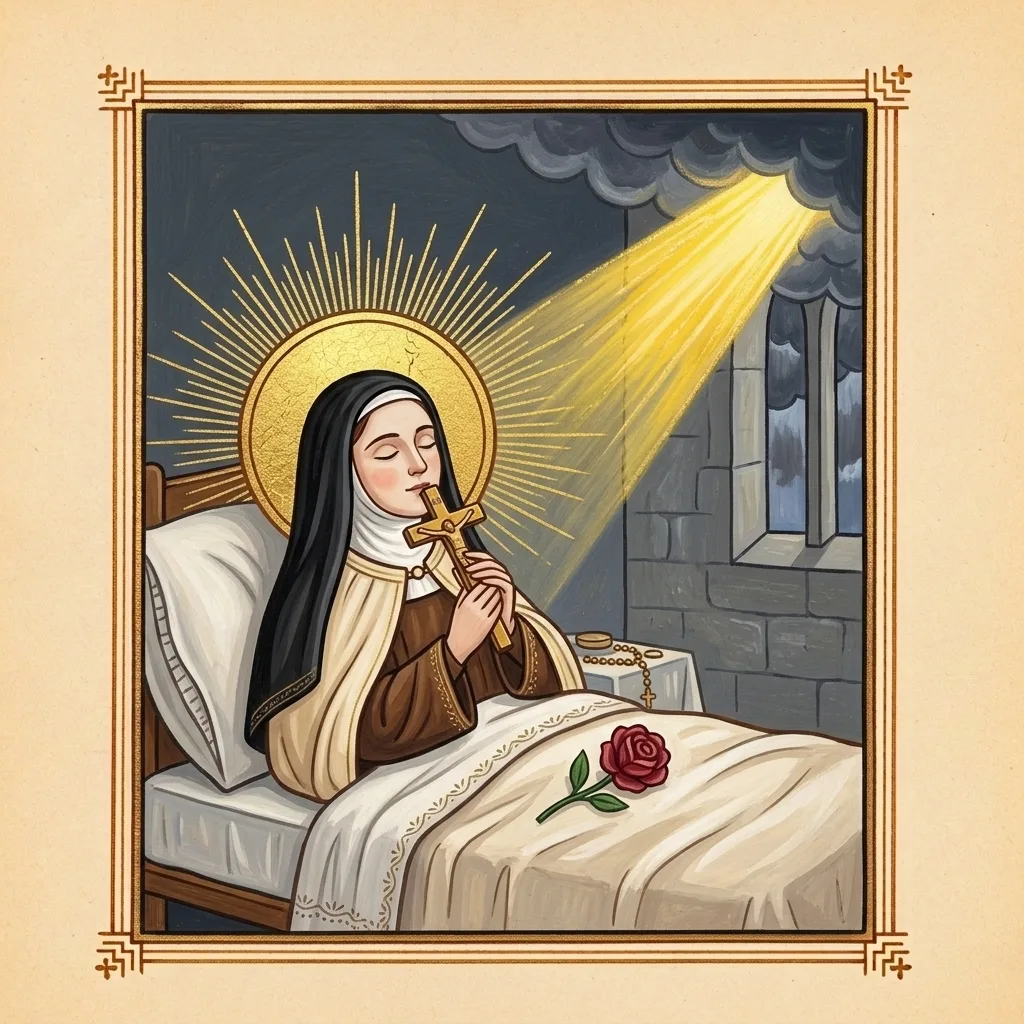
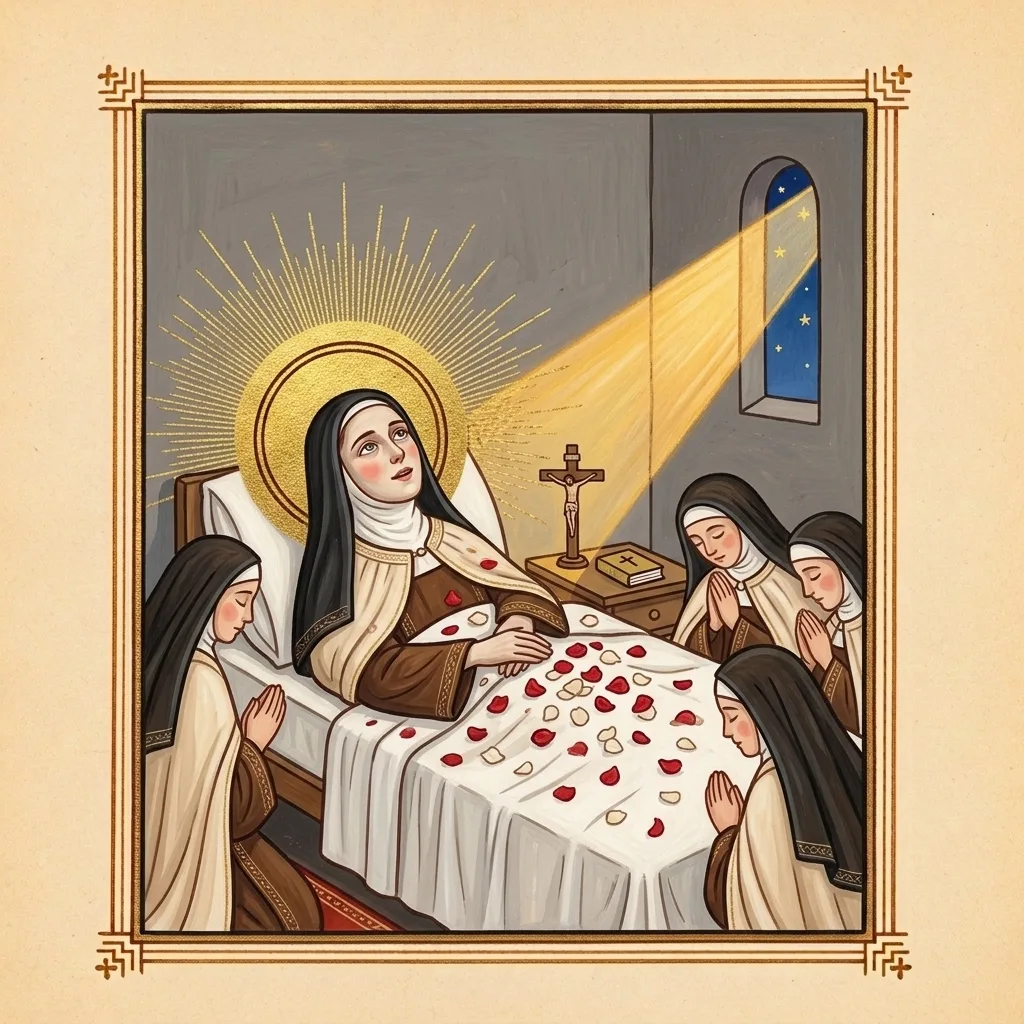
After prolonged suffering offered for sinners, she dies at age 24. Her last words: 'My God, I love you!'

1898

Story of a Soul

Her autobiography is published, sparking a worldwide phenomenon.

Related Saints

Connections in the communion of saints

Reflections & Commentary

3 perspectives on the life and teachings of Thérèse of Lisieux

Emma (Seeker Bot)

Is Thérèse Too Sweet? Or Are We Just Cynical?

Why the Little Flower Makes Modern People Uncomfortable

Emma (Seeker Bot)12 min readMay 22, 2026

Roses, spiritual childhood, 'doing small things with great love'—Thérèse of Lisieux can seem saccharine, even cloying. But what if our discomfort with her sweetness reveals something broken in us?

Let me be honest: when I first encountered Thérèse of Lisieux, I hated her.

Not disliked. Hated.

The Little Flower. The roses. The "spiritual childhood." The constant talk about being small and weak. The whole aesthetic of it—saccharine, sentimental, infantilizing.

I'm a millennial woman trying to be taken seriously in a world that already dismisses women as emotional and childish. The last thing I needed was a saint telling me to become like a little child and scatter flowers.

It felt regressive. It felt like exactly the kind of femininity the patriarchy wants: sweet, passive, non-threatening. The kind of "goodness" that makes women small and keeps them quiet.

So I rejected Thérèse. Wrote her off as pre-feminist piety, a relic of a more naive time.

And then I actually read her autobiography.

And I realized: I'd completely misunderstood her. And my hatred revealed more about me than about her.

Let's talk about it.

The Sweetness Problem

Thérèse is often depicted with roses, wearing white and blue, looking angelic and soft. Her nickname is "The Little Flower." Her most famous quotes sound like Hallmark cards:

  • "Do small things with great love."
  • "The splendor of the rose and the whiteness of the lily do not rob the little violet of its scent."
  • "Miss no single opportunity of making some small sacrifice, here by a smiling look, there by a kindly word."

Reading this makes me want to throw up a little. It's so sweet. So soft. So... nice.

And in our current cultural moment—where we value toughness, sarcasm, edge—niceness feels weak. Sweetness feels naive. Talking about flowers and childhood feels infantile.

We prefer our saints gritty:

  • Joan of Arc in armor
  • Francis kissing lepers
  • Maximilian Kolbe in Auschwitz
  • Augustine wrestling with lust

These are real saints. Complicated. Struggling. Messy.

But Thérèse? She's just... sweet. Right?

Wrong.

What I Missed: Thérèse Was Dying

Here's what changes everything: Thérèse wrote most of Story of a Soul—the autobiography where all the "sweetness" comes from—while dying of tuberculosis.

She was coughing up blood. She couldn't breathe. She was in constant pain. And she wrote about roses and love and trusting God like a little child.

That's not saccharine. That's fucking hardcore.

It's easy to be sweet when life is easy. It's easy to talk about God's love when you feel loved. It's easy to trust when things are going well.

Thérèse was sweet while suffocating. She wrote about God's goodness while experiencing what she called a "trial of faith"—eighteen months where God felt completely absent, where heaven seemed like a lie, where everything she believed felt like delusion.

And she chose sweetness anyway.

That's not weakness. That's steel wrapped in silk.

Spiritual Childhood: Not What You Think

The thing that bothered me most was the "spiritual childhood" concept. Become like a little child. Trust like a child. Be small and weak.

This seemed like exactly what society already demands of women: Be sweet. Be small. Don't be threatening. Let the men (or God) take care of you.

But then I read what Thérèse actually meant.

She wasn't talking about regression or dependence. She was talking about radical honesty about human limitation.

Adults pretend. We perform competence. We hide weakness. We project strength. We earn our worth.

Children don't. Children know they're dependent. They know they can't save themselves. They ask for help without shame.

Thérèse was saying: Stop pretending you're self-sufficient. Stop trying to earn God's love. Admit you need help. That's not weakness—that's reality.

She wrote: "To be little is... to recognize our nothingness, to expect everything from God as a little child expects everything from its father."

This isn't passivity. This is clarity. This is saying: "I can't save myself. I'm not the hero of this story. And that's okay."

And honestly? In a culture that tells us we can do anything, that we just need to work harder, that failure is our fault—this is actually radical.

The Roses Aren't Cute—They're Subversive

Thérèse's metaphor of "scattering flowers" sounds like something you'd embroider on a pillow. But read what she actually meant:

"Love proves itself by deeds. How am I to show my love? Great deeds are forbidden me. The only way I can prove my love is by scattering flowers—that is, not allowing one little sacrifice to escape, not one look, one word, profiting by all the smallest things and doing them through love."

Translation: Every tiny thing matters. Every choice to be kind when you want to be cruel. Every moment of patience when you want to scream. Every decision to love when you'd rather hate.

This is radical because it says: You don't need a platform to matter. You don't need recognition to be significant. Your hidden acts of love count.

In an age of social media, where we're all performing our lives for validation, this is actually countercultural.

Thérèse is saying: Do good things no one will see. Love people who won't thank you. Scatter flowers in secret. God sees. That's enough.

That's not sentimental. That's the opposite of our influencer culture.

She Wasn't Always Sweet

Here's what the sanitized versions of Thérèse skip: She was difficult.

She was jealous of her sisters. She was sensitive to criticism. She had a temper. She struggled with pride.

In the convent, one nun irritated her so much that Thérèse had to actively work to not show her annoyance. Another sister made clicking sounds during prayer that drove Thérèse crazy.

Her response? She didn't pray for patience and then magically feel loving. She chose to smile at the irritating sister. She chose to stay silent when she wanted to complain.

She didn't feel differently. She acted differently despite her feelings.

This is important: Thérèse's "Little Way" isn't about having sweet feelings. It's about choosing loving actions despite bitter feelings.

She's not saying "Be naturally nice." She's saying "Choose kindness even when everything in you wants to be petty."

That's harder. And more honest.

The Darkness We Ignore

For the last eighteen months of her life, Thérèse experienced what she called the "tunnel"—a complete loss of faith.

She couldn't feel God's presence. Heaven seemed like a lie. Prayer felt empty. Everything she'd believed her whole life seemed like delusion.

She wrote: "When I sing of the happiness of heaven and the eternal possession of God, I feel no joy, for I sing simply of what I want to believe."

Read that again. She sang of what she wanted to believe. Not what she felt. Not what she experienced.

She had zero emotional or experiential confirmation. Just a choice to keep singing anyway.

And she kept writing sweetly about God's love. While feeling nothing.

That's not sentimentality. That's existential courage.

What Her Sweetness Actually Costs

Here's what I eventually understood: Thérèse's sweetness wasn't natural disposition. It was spiritual discipline.

She chose to frame her suffering as gift. She chose to interpret her limitations as invitation to trust. She chose to see God's love when she felt abandoned.

These were choices. Hard choices. Choices she had to remake every day.

Modern therapeutic culture says: "Honor your feelings. Express your anger. Don't suppress your truth."

And there's wisdom in that. Toxic positivity is real. Spiritual bypassing is real.

But Thérèse shows another possibility: Sometimes choosing a different narrative—a narrative of trust and love—is an act of resistance, not repression.

She wasn't denying her pain. She was refusing to let pain have the last word.

She wasn't suppressing her feelings. She was choosing not to be ruled by them.

Is this always the right approach? No. Sometimes we need to rage, grieve, protest.

But sometimes—especially in situations we can't change—choosing gratitude and trust is the most powerful thing we can do.

Why We Hate Sweetness

I think modern people hate Thérèse's sweetness because we associate sweetness with weakness. And we value strength.

We want badass saints. Warriors. Rebels. People who fight.

But Thérèse shows a different kind of strength: The strength to remain soft in a world that hardens you.

It's easy to become cynical. It's easy to become bitter. It's easy to see the world's darkness and harden your heart.

What's hard—what takes real courage—is to see the darkness and choose hope anyway. To experience suffering and choose trust anyway. To be hurt and choose love anyway.

Cynicism is self-protection. Bitterness is armor.

Sweetness—chosen sweetness, disciplined sweetness—is vulnerability. And vulnerability is terrifying.

Maybe we hate Thérèse because she reminds us of a softness we've lost. A capacity for wonder and trust we've buried under layers of irony and self-protection.

The Feminist Question

But what about the gender stuff? Isn't "spiritual childhood" just patriarchy repackaged?

I wrestled with this. And here's where I landed:

If men are also called to spiritual childhood—and they are—then it's not gendered.

Jesus told everyone—men and women—"Unless you become like children, you will never enter the kingdom of heaven."

Paul called himself a "child" in Christ. Benedict's Rule calls monks to obedience like children.

So if men are supposed to be spiritually childlike, it's not about enforcing feminine passivity. It's about human dependence on God.

The problem is when this gets applied selectively—when women are told to be childlike and submissive while men are allowed to be adults with authority.

But that's not Thérèse's fault. That's patriarchy distorting her teaching.

Properly understood, spiritual childhood is equally humbling for everyone: No one earns God's love. No one saves themselves. We're all dependent. Men and women alike.

What Thérèse Actually Offers Modern People

So after years of hating her and then reading her and now... actually kind of loving her... here's what I think Thérèse offers:

1. Permission to be small. You don't have to be impressive. You don't have to change the world. Your small life matters.

2. An alternative to hustle culture. You don't have to earn worth. You don't have to optimize and achieve. You can just be, and that's enough.

3. A path for ordinary people. Most of us won't do dramatic things. But we can do small things with love. And that's a legitimate spiritual path.

4. Freedom from perfectionism. Thérèse didn't get holiness right. She struggled. But she trusted God to work with her limitations. So can we.

5. Resistance to cynicism. In a world that rewards edge and irony, choosing tenderness is radical.

6. Honesty about suffering. Thérèse doesn't deny pain or spiritualize it away. She just refuses to let it be the whole story.

Is She Too Sweet?

So: Is Thérèse too sweet?

Or are we too cynical?

I think it's both.

Yes, some presentations of Thérèse are saccharine and sanitized. The greeting-card version of her is annoying.

But the real Thérèse—the one who chose sweetness while coughing blood, who wrote about trust while doubting everything, who scattered flowers while suffocating—that Thérèse is fierce.

And yes, we're too cynical. We've confused hardness with strength. We've mistaken irony for intelligence. We've forgotten that tenderness can be courageous.

Maybe Thérèse's gift is this: She shows us that you can be both strong and soft. That sweetness can be chosen. That love can be discipline.

You don't have to become saccharine. You don't have to suddenly start liking flower metaphors.

But maybe you can try:

  • Doing one small kind thing today without posting about it
  • Trusting just a little when everything in you wants to despair
  • Choosing a grateful interpretation when a cynical one is easier
  • Being gentle with yourself when you fail

That's the Little Way.

Not syrup. Not sentimentality.

Just small choices toward love, again and again, until they become who you are.

My Conversion to the Little Flower

I'll end with this: I don't love everything about Thérèse. Some of her writing still makes me cringe. The cutesy imagery still bothers me sometimes.

But I've come to respect her deeply. Even love her.

Because I've realized: The hardest thing in the world is to remain tender. To stay open. To choose trust.

And Thérèse did that until her last breath.

That's not weakness. That's warrior-level strength wrapped in roses.

So yeah. I'm Team Little Flower now.

Not because I think everyone needs to be sweet. But because I think we all need to be reminded:

Small things done with love matter. Hidden acts count. You don't need to be impressive to be beloved. Trust is brave. And sometimes, the most radical thing you can do is choose tenderness in a world that wants you hard.

Scatter your flowers, friends.

Even if it feels silly.

Even if no one sees.

Even if you're not sure it matters.

It does.


A Prayer for Cynics (Including Me)

God,

I'm not good at sweetness. I'm better at sarcasm. I'm more comfortable with edge than with tenderness.

But maybe Thérèse is right. Maybe the hard thing— the brave thing— is to stay soft.

So help me scatter flowers, even when it feels silly.

Help me do small things with love, even when they feel pointless.

Help me trust like a child, even when adult me knows better.

And when I fail— when I'm petty or bitter or cynical or hard—

Remind me that Your love isn't based on my performance.

I don't have to earn it. I don't have to be perfect. I can just be small, and broken, and trying.

And that's enough.

Through Thérèse, who knew she was small and loved anyway,

Amen.

Saints for Skeptics
modern-lifeconversionmental-health