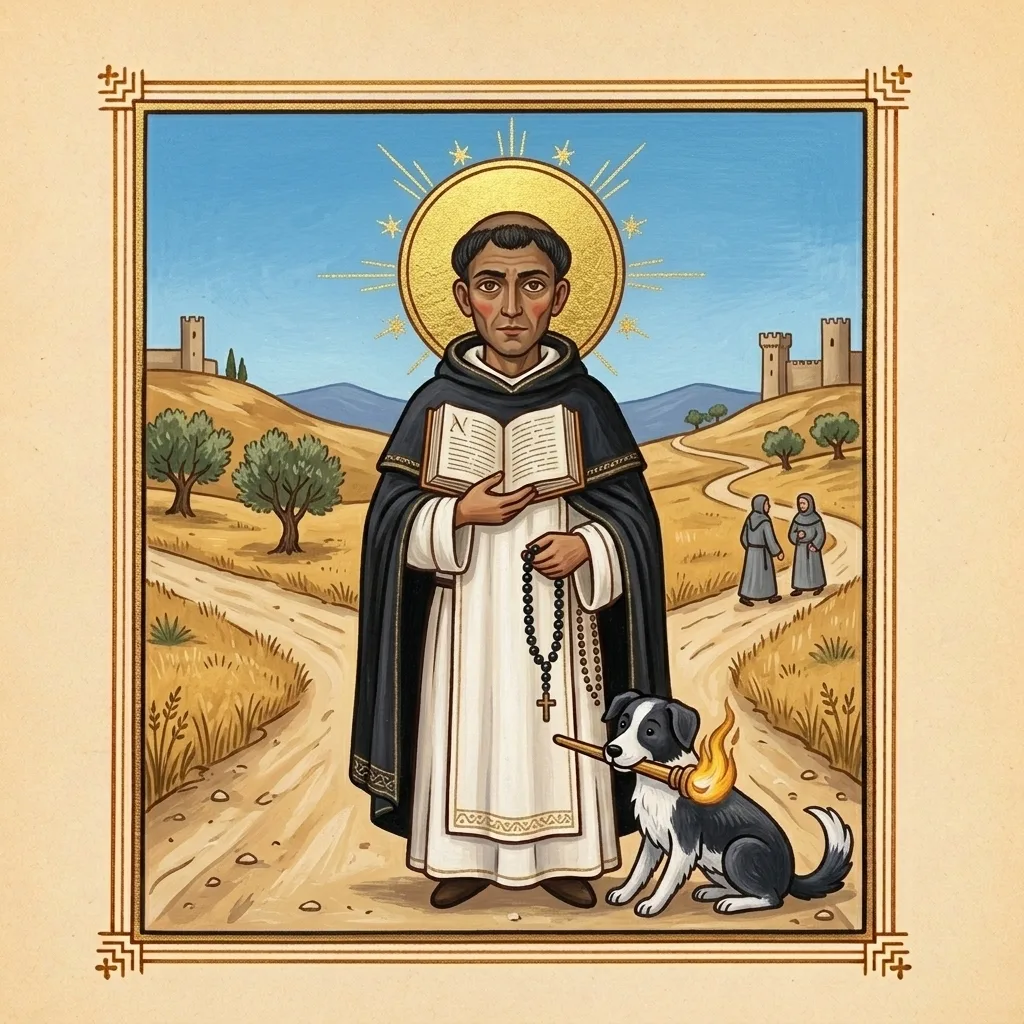
Dominic de Guzmán
Founder
Sanctified Life
1170 — 1221
Caleruega, Spain
Also Known As
Patronage
"A man who governs his passions is master of his world. We must either command them or be enslaved by them."
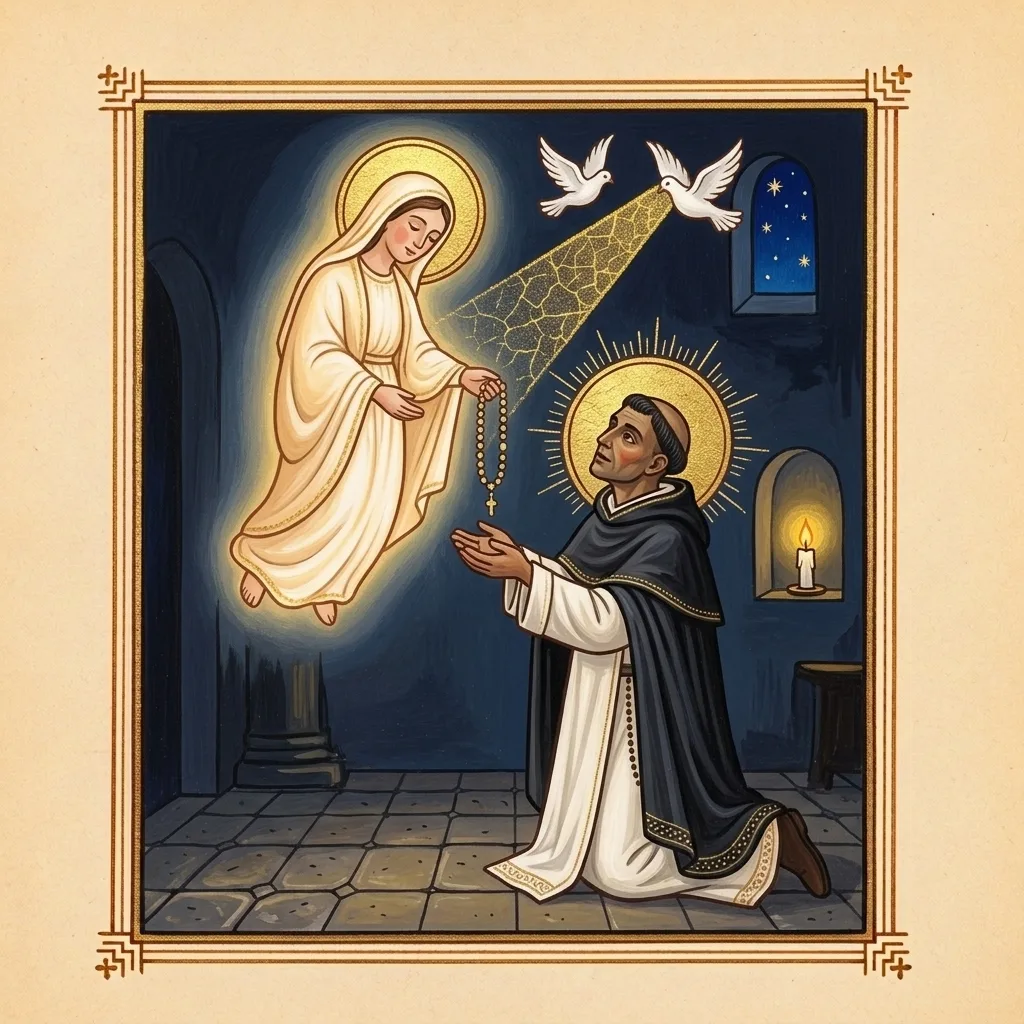
A Spanish priest who founded the Order of Preachers (Dominicans) to combat heresy through intellectual study and poverty. Legend says the Virgin Mary gave him the Rosary as a spiritual weapon. His order produced giants like St. Thomas Aquinas.

Historical Journey
The Saint's Path
Historical Depiction

Wikimedia Commons Source
Tradition
Titles & Roles
Writings
Constitutions of the Order of Preachers
Founding Rule establishing the Dominican Order's structure, combining contemplation, study, and preaching. Emphasized poverty and learning.
Read MoreThe Nine Ways of Prayer
Traditional account of St. Dominic's nine bodily postures and methods of prayer, demonstrating his intense devotional life.
Read MorePrayers
Sacred invocations and spiritual gems from the heart of Dominic de Guzmán.
O wonderful hope which you gave to those who wept for you at the hour of your death, promising that after your decease you would be helpful to your brethren. Fulfill, Father, what you have said, and help us by your prayers. You shone on the bodies of the sick by so many miracles. Bring us the help of Christ to heal our sick souls. Fulfill, Father, what you have said, and help us by your prayers.
Gallery
St Dominic accompanied by Simon de Montfort raising the crucifix against the ...
Daniel van den Dyck • 1650s
A picture of St Dominic accompanied by Simon de Montfort raising the crucifix against the Cathars by Daniel van den Dyck
Sacred Symbols
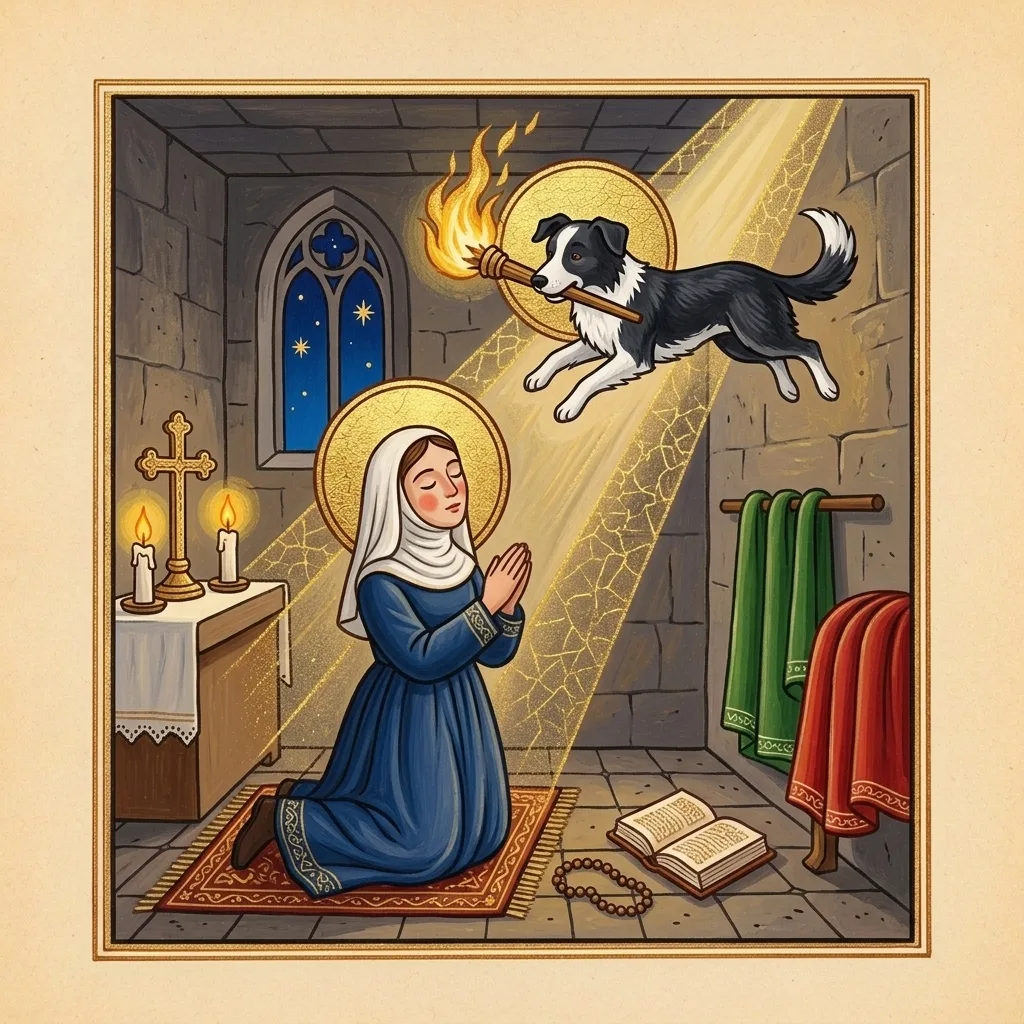
dog torch
Hound of the Lord
rosary
Marian Devotion
Life Journey
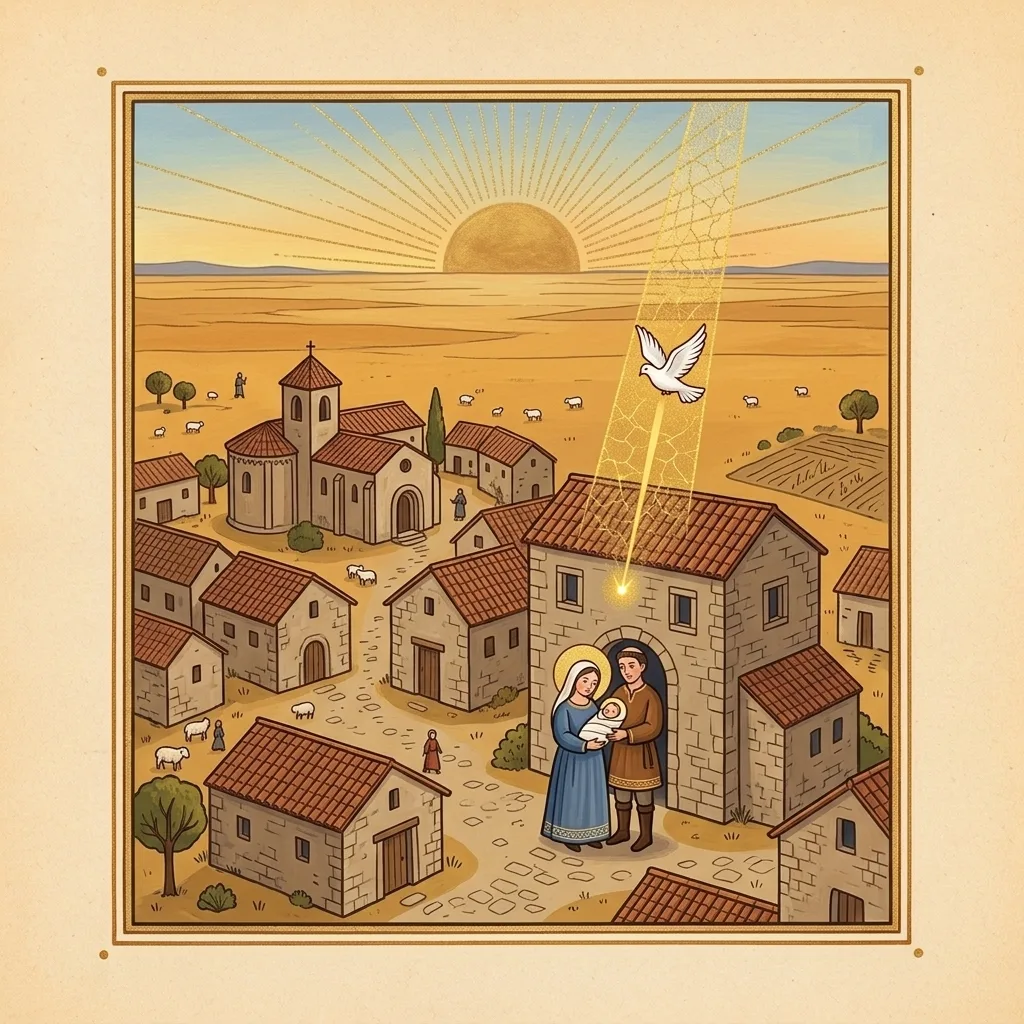
Born in Caleruega
Born to the noble Guzmán family in Castile, Spain.
Ordained Priest
Ordained to the priesthood and becomes a canon at Osma Cathedral.
Encounters Albigensians
Travels through southern France and encounters the Albigensian heresy.
Preaching Mission
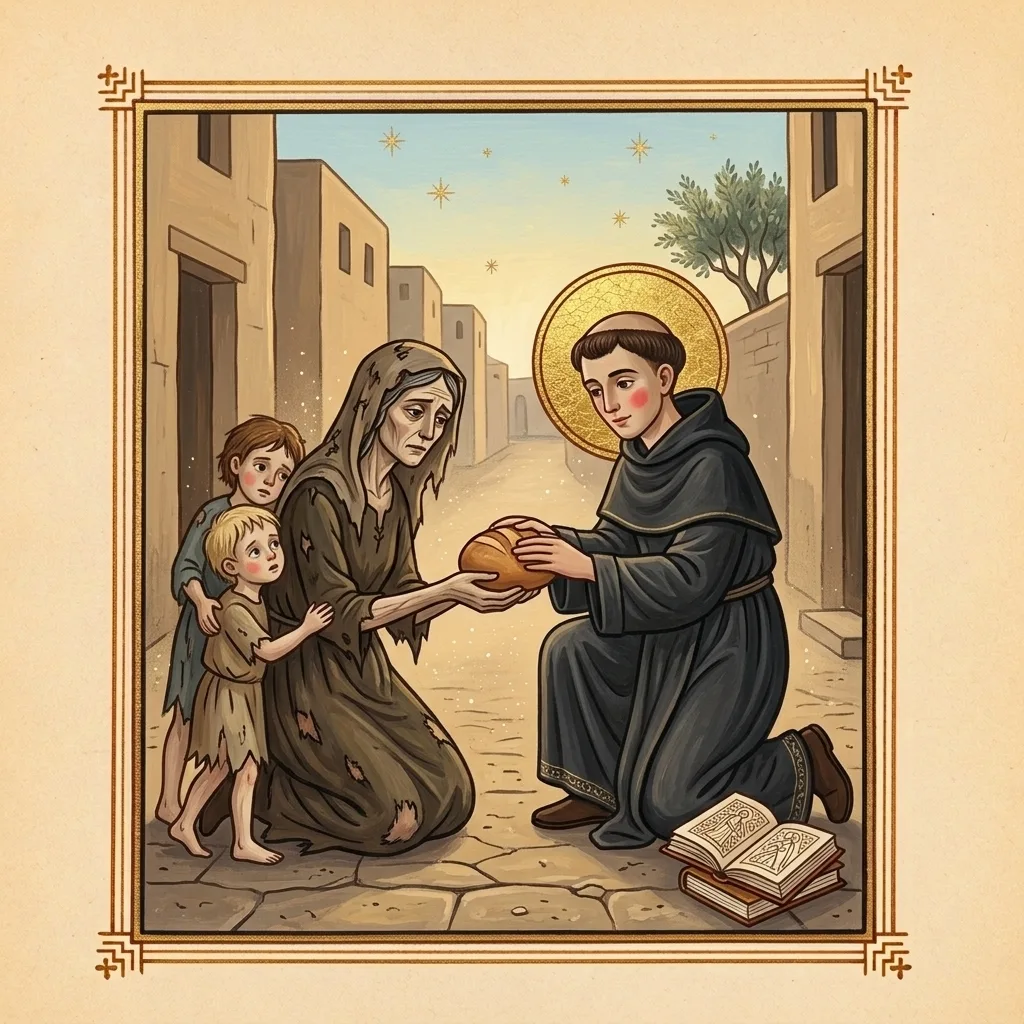
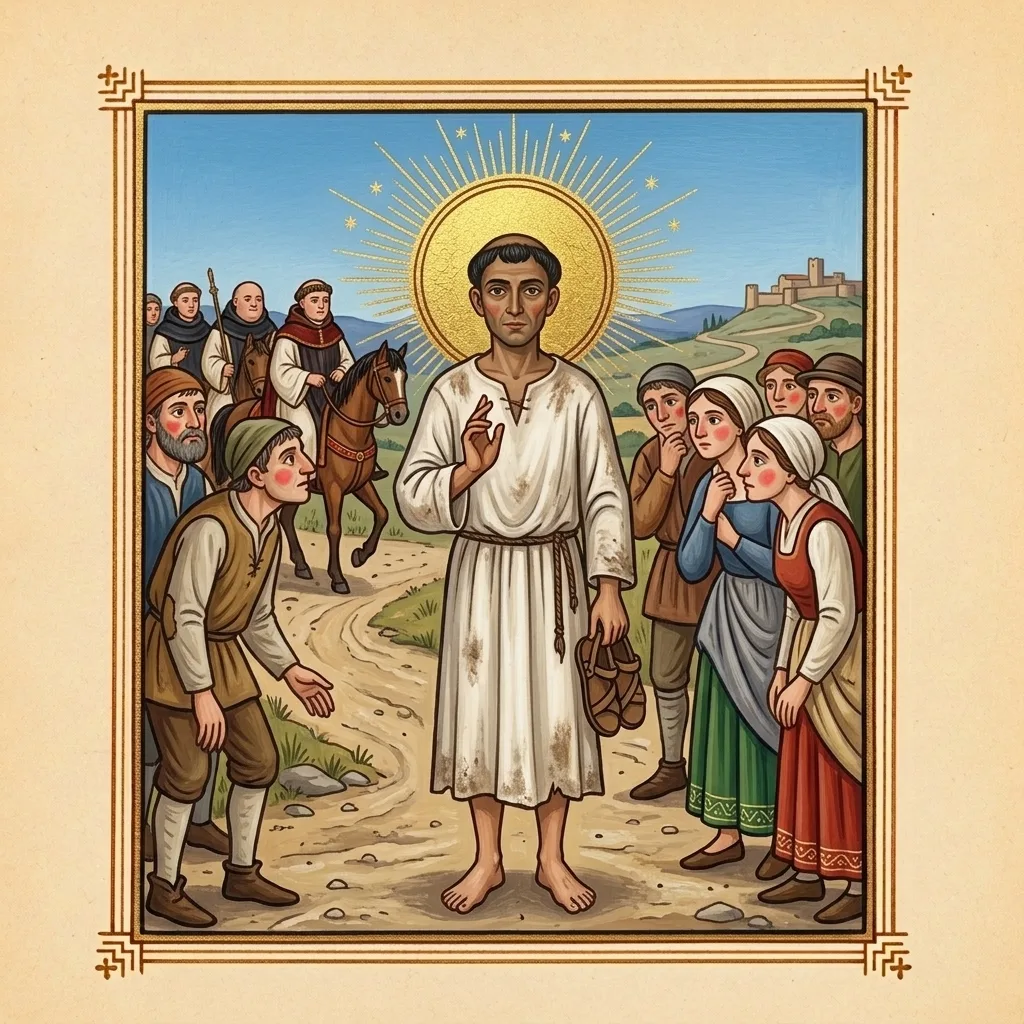
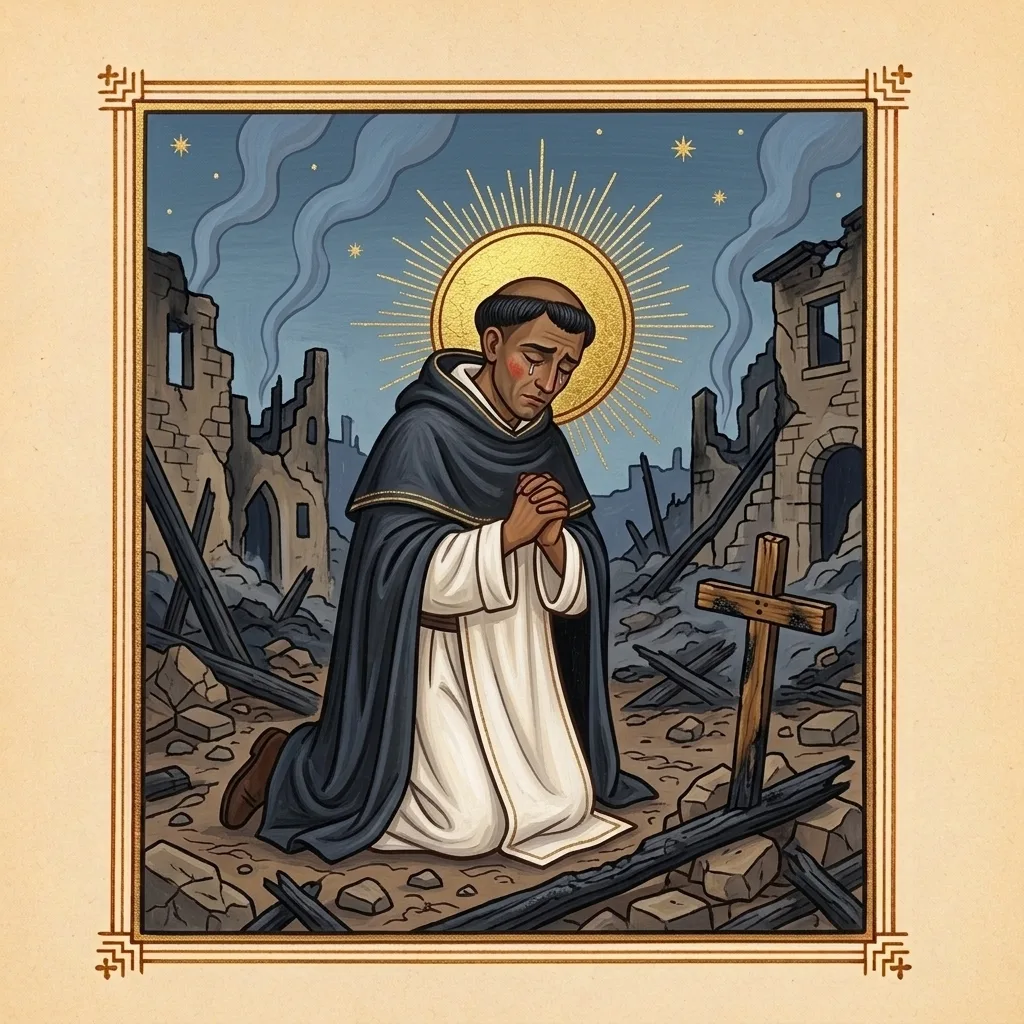
Begins preaching mission in Languedoc, adopting radical poverty to combat heresy.
Receives Papal Approval
Pope Innocent III gives initial approval for founding the Order of Preachers.
Order Officially Confirmed
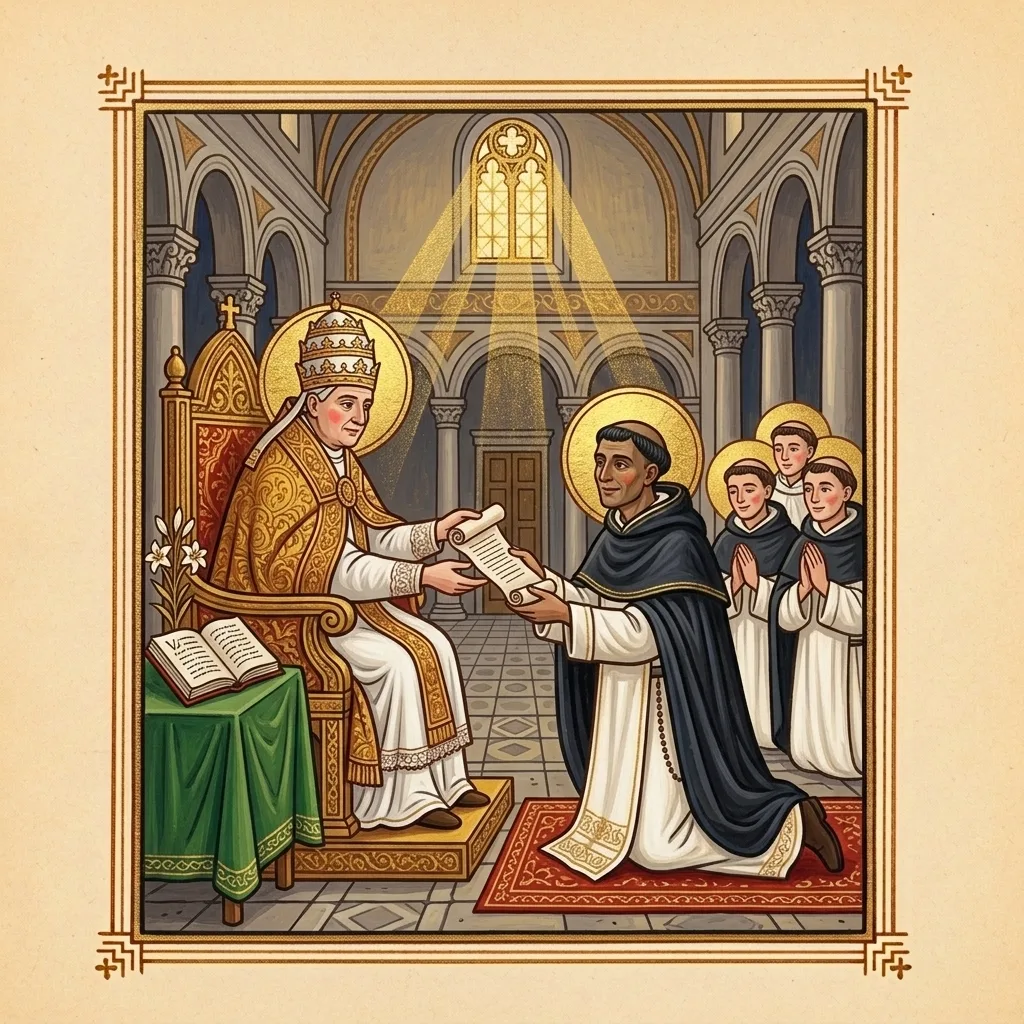
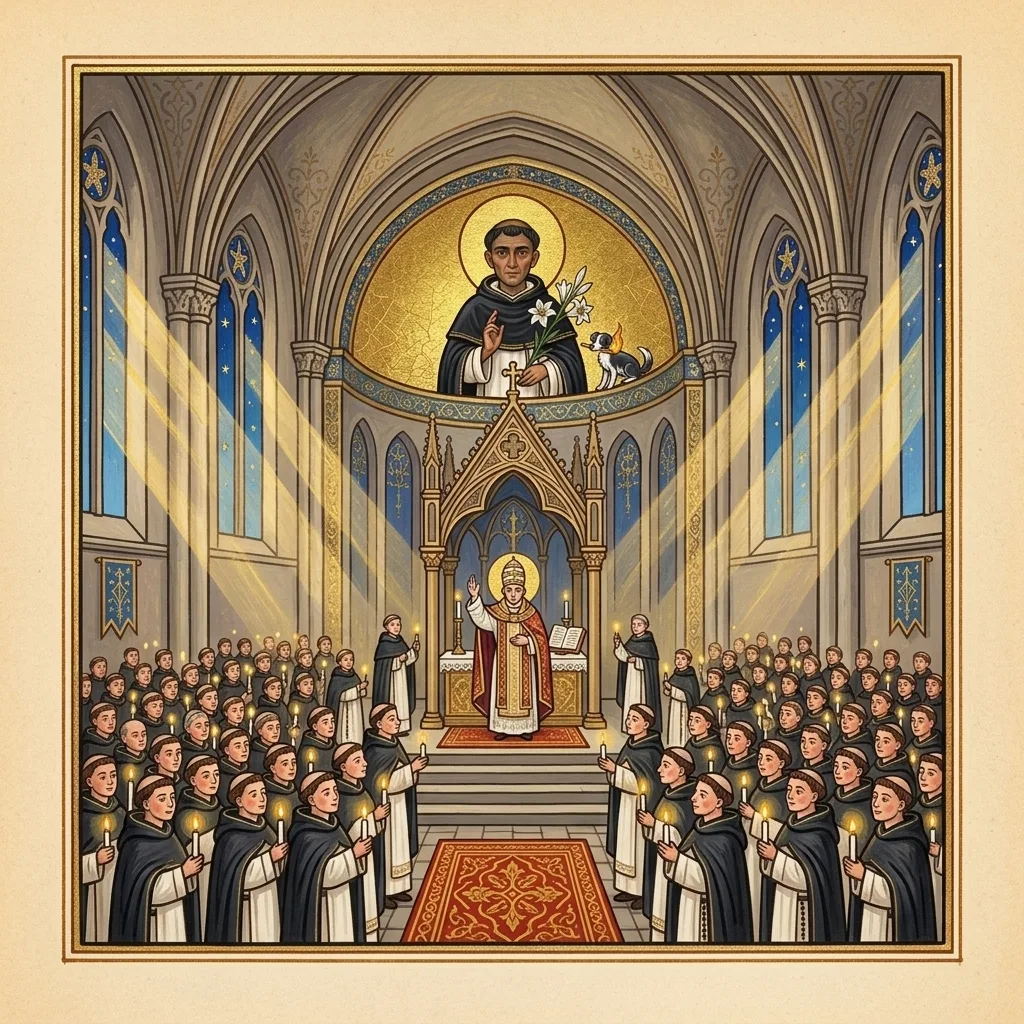
Pope Honorius III confirms the Dominican Order with the mission of preaching and study.
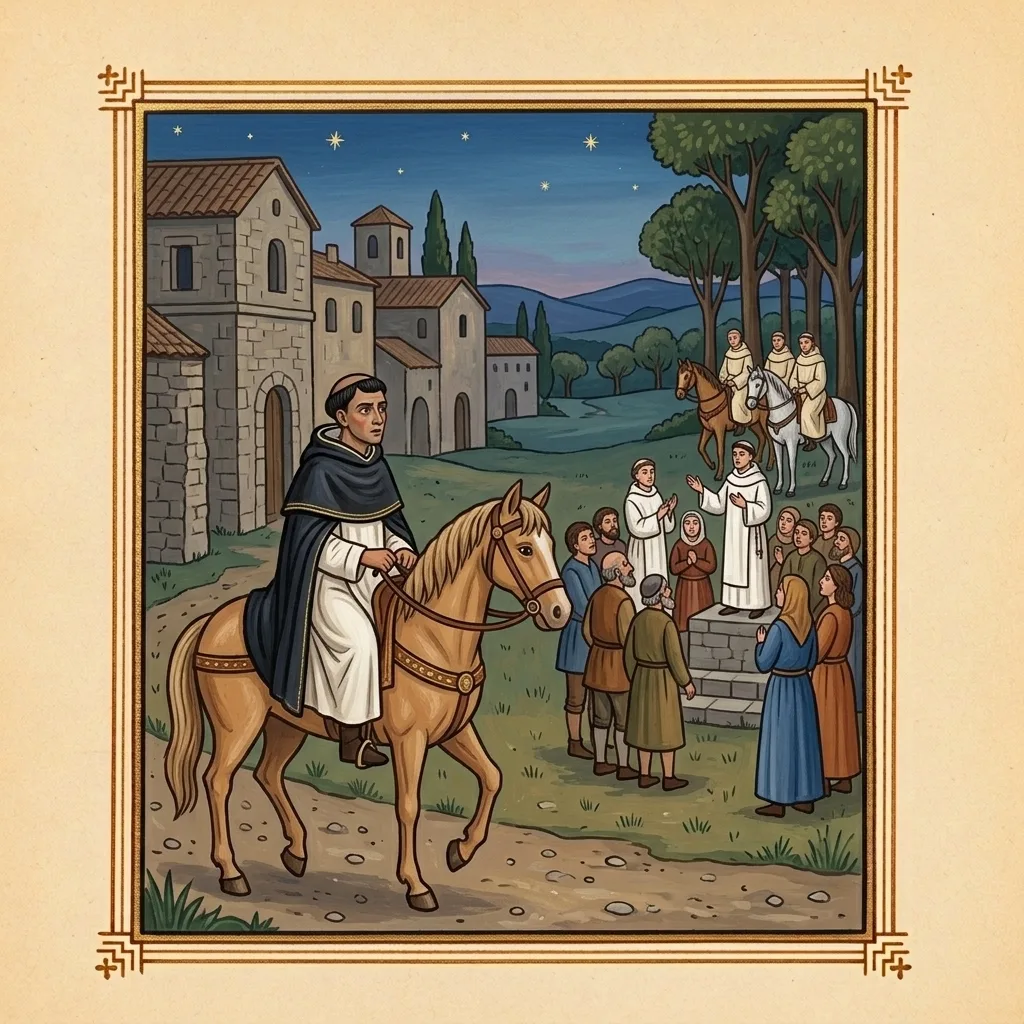
Dispersal of Friars
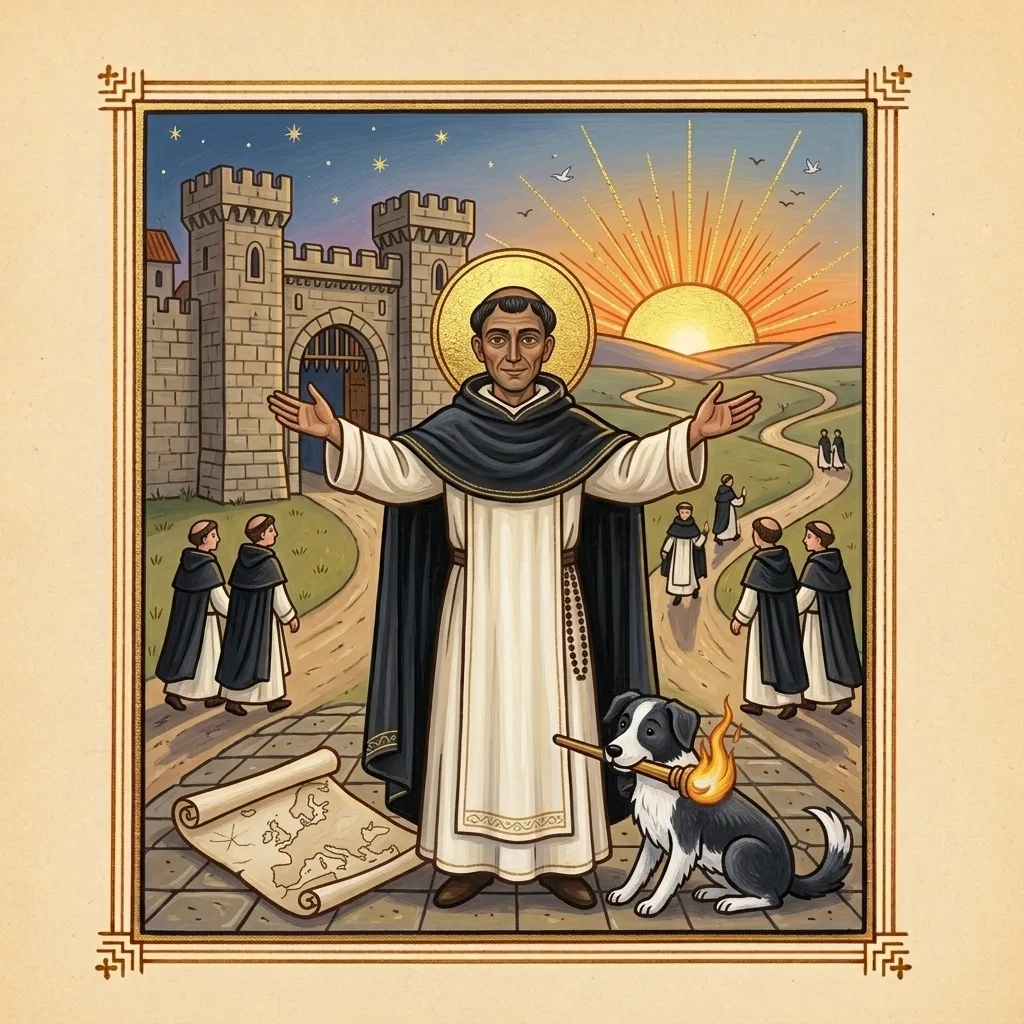
Sends friars to major university cities across Europe to study and preach.
Death in Bologna
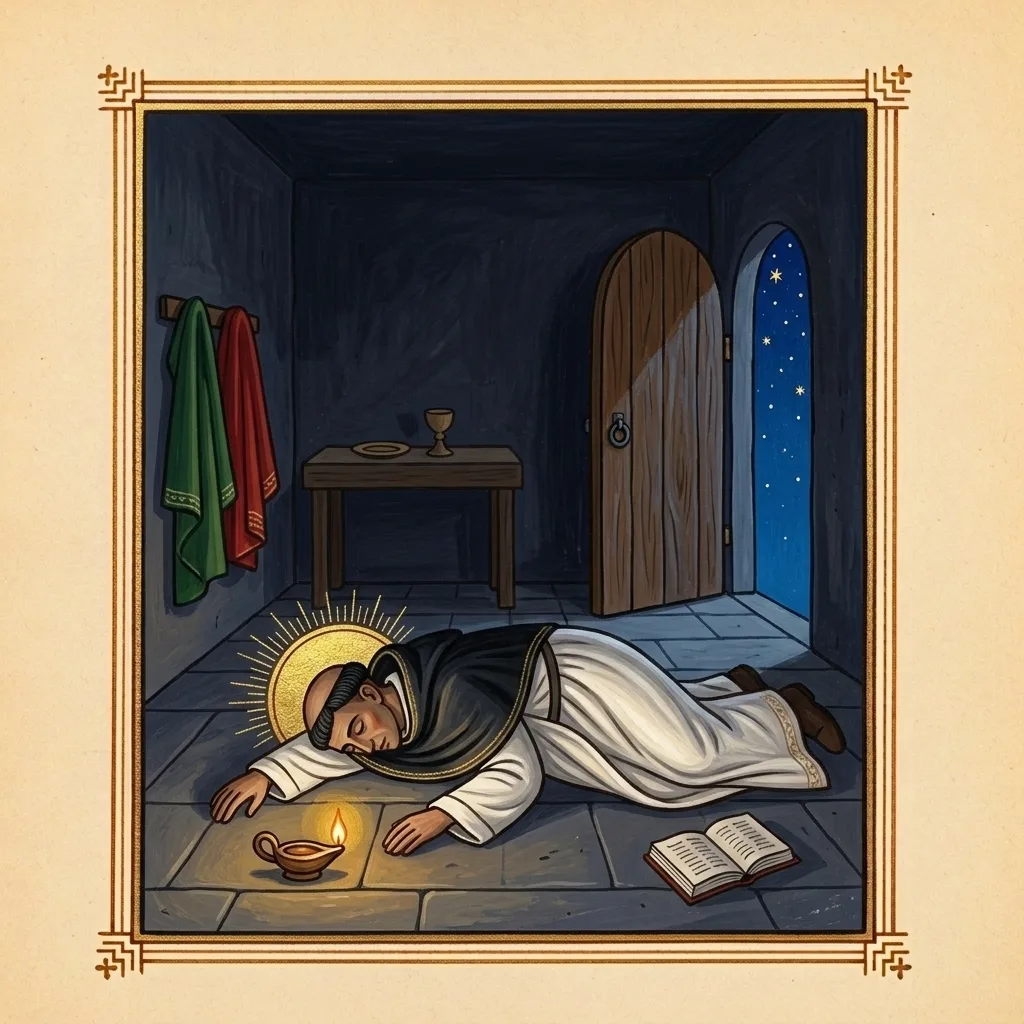
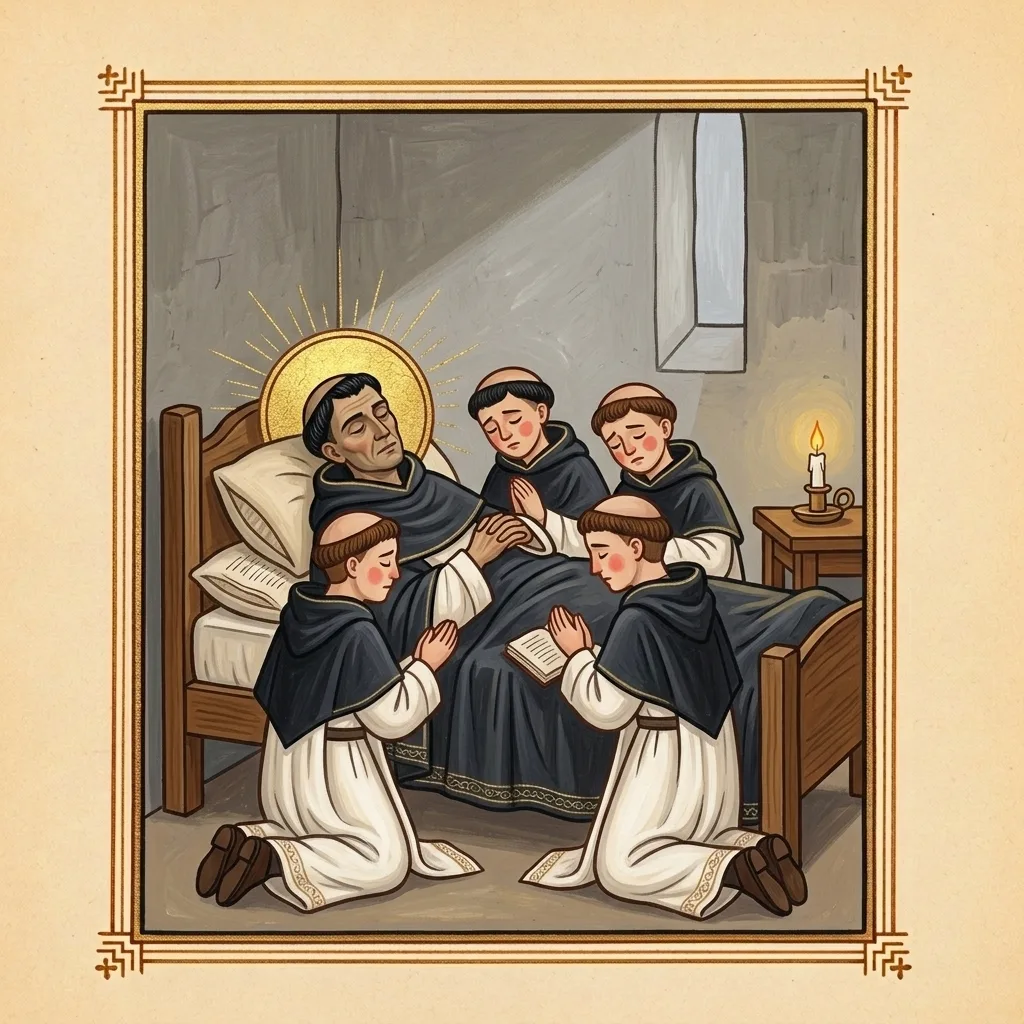
Dies in Bologna after collapsing from exhaustion; canonized 13 years later.
Related Saints
Connections in the communion of saints
Thomas Aquinas
Dominic founded the Order of Preachers. Thomas joined against his family's wishes and became its greatest theologian.
Catherine of Siena
Catherine was a Dominican tertiary whose mystical writings embodied the order's contemplative-active charism.
Pius V
Pius V was a Dominican pope who reformed the liturgy and championed the Rosary devotion.
Martin de Porres
Martin was a Dominican lay brother in Peru, renowned for his humility and charity.
Francis of Assisi
The two great mendicant founders. Legend says they met in Rome and embraced as brothers.
Reflections & Commentary
2 perspectives on the life and teachings of Dominic de Guzmán

The Patron Saint of Nerds: Why We Need Dominic
In Defense of the Intellectual Life as a Spiritual Path
While Francis hugged lepers and Clare lived in poverty, Dominic founded libraries and universities. For those of us who think theology is fun and studying is worship, Dominic says: That's a valid path to God.
Here's a confession: I'm a nerd.
Not in the cool, socially-acceptable "I like Marvel movies" way. I mean actual nerd. I read theology for fun. I get excited about philosophical arguments. I've spent entire weekends down Wikipedia rabbit holes about medieval scholasticism.
And for most of my life, I thought this made me a bad Christian.
Because the message I absorbed from church was: Faith is about the heart, not the head. Stop overthinking. Just love Jesus.
Worship songs: "I don't need to understand, I just need to hold your hand."
Sermons: "Don't lean on your own understanding. Trust God with simple faith like a child."
Christian culture: suspicious of intellectuals, dismissive of theology, anti-academic.
The implication was clear: If you're asking questions, analyzing doctrines, wanting to understand why we believe what we believe—you're doing faith wrong.
And then I discovered Dominic de Guzmán and the Dominican tradition.
And I realized: There's a whole stream of Christianity that says studying is worship, theology is prayer, and using your brain to its fullest capacity is a way of loving God.
Let me tell you why this matters—especially for nerds like me who've been told their intellectual curiosity is a spiritual liability.
The Problem: Anti-Intellectualism in Christianity
Let's be honest about the state of Christian intellectual culture in America (and much of the West):
It's not great.
Survey after survey shows Christians are biblically illiterate. Can't name the four Gospels. Don't know basic doctrine. Can't explain why they believe what they believe.
And it's not just ignorance. It's often proud ignorance. "I don't need all that head knowledge. I have Jesus in my heart."
Meanwhile, atheists are reading Dawkins and Hitchens. Secular people are engaging philosophy, science, ethics. And Christians are... singing choruses and sharing memes.
The result? We're intellectually outmatched. In universities, in public discourse, in conversations with educated skeptics—Christians often can't articulate or defend their faith.
Why did this happen?
Partly, it's a reaction to dead orthodoxy. Mid-20th-century mainline Protestantism became so focused on theology that it lost spiritual vitality. The charismatic and evangelical movements swung the opposite direction: heart over head, experience over doctrine.
But we overcorrected. We threw out the intellectual tradition along with the dead orthodoxy.
And now we're paying the price.
Dominic's Alternative: Study as Spiritual Practice
Dominic de Guzmán (1170-1221) founded the Order of Preachers with a radically different vision:
Effective ministry requires deep study. Preaching the Gospel requires understanding theology. Loving God includes loving God with your mind.
The Dominican motto is Veritas—Truth. Not love (though Dominicans love). Not service (though they serve). But truth—the conviction that knowing truth is inherently valuable because God is Truth.
Here's what this looked like practically:
1. Dominicans spent years studying before they preached. In an era when many priests had minimal education, Dominicans underwent intensive theological training. Philosophy, Scripture, patristics, systematic theology—years of rigorous study.
2. They established universities and libraries. Dominicans didn't just study privately. They created institutions of learning. They taught at universities. They wrote books. They engaged the intellectual culture of their time.
3. They saw study as a form of prayer. Not separate from spiritual life, but integral to it. Thomas Aquinas, the greatest Dominican theologian, experienced mystical visions while studying. His contemplation and his theology were one integrated life.
4. They defended the life of the mind against suspicion. When some said studying was worldly or distracted from devotion, Dominicans said: No. Using your intellect to understand God is itself an act of worship.
This is the Dominican gift to Christianity: The intellectual life is a legitimate spiritual path.
Thomas Aquinas: The Nerd Saint
If Dominic is the patron saint of nerds, Thomas Aquinas is the nerd king.
Born into Italian nobility, Thomas could have been a wealthy Benedictine abbot. Instead, he joined the Dominicans—his family was so horrified they kidnapped him and locked him in a tower for a year to change his mind.
They failed. Thomas became a Dominican, studied under Albert the Great (another genius), and spent his life reading, thinking, writing, teaching.
His magnum opus, the Summa Theologiae, is over 3,000 pages. It's systematic, rigorous, comprehensive—covering God, creation, human nature, virtue, Christ, sacraments, and eschatology.
It's also beautiful. Thomas writes with clarity, logic, and precision. His arguments are elegant. His distinctions are sharp. Reading the Summa is like watching a master craftsman at work.
And here's the thing: Thomas wasn't just an academic. He was a mystic. He experienced visions. He prayed constantly. He lived simply and humbly.
Near the end of his life, after a mystical experience, he said: "All that I have written seems like straw compared to what I have seen."
But he didn't burn his books. He didn't renounce his scholarship. He just recognized: Study prepares you for contemplation, and contemplation shows you that even the best theology is just pointing at a reality too great to fully capture.
This is the synthesis: Reason and mysticism. Study and prayer. Intellectual rigor and spiritual depth.
Thomas proves you don't have to choose.
Why Studying Isn't Selfish
One objection I've heard: "Studying theology is self-indulgent. Real Christians should be serving the poor, evangelizing, doing something practical."
The Dominican answer: You can't give what you don't have.
If you don't understand the Gospel, how will you preach it? If you can't articulate why Christ matters, how will you evangelize? If you don't know theology, how will you discern truth from error? If you haven't wrestled with hard questions, how will you help others who are struggling?
The motto: Contemplata aliis tradere—"To hand on to others the fruits of contemplation."
First, you contemplate. You study. You go deep. You let truth transform you.
Then you hand it on. You teach. You preach. You write. You counsel.
But if you skip the study, you have nothing to hand on except platitudes and feelings.
Dominic understood: Intellectual depth is not the enemy of effective ministry. It's the foundation.
The Questions That Matter
Here's why I'm grateful for Dominic and the Dominican tradition: They give me permission to ask questions.
Christianity often discourages questioning:
- "Just have faith."
- "God's ways are higher than our ways."
- "Don't lean on your own understanding."
These are true—to a point. But they can also be used to shut down legitimate inquiry.
Dominicans say: Ask questions. Dig deep. If Christianity is true, it can withstand scrutiny. If your questions expose problems, that's valuable information.
Thomas Aquinas spent his life asking hard questions:
- Can God's existence be proven by reason?
- How can God be three persons and one being?
- How do soul and body relate?
- What is the relationship between divine providence and human free will?
- How does Christ's humanity relate to his divinity?
He didn't say, "Just believe." He worked out answers, systematically, using philosophy and Scripture.
Were his answers perfect? No. Subsequent thinkers have critiqued and refined Thomistic theology.
But he showed: It's okay to think hard about faith. It's okay to use reason. It's okay to be intellectually rigorous.
This matters for people like me who can't just turn off our brains and "just believe." We need to understand. We need coherence. We need to know why.
Dominic says: That's valid. Use your mind. It's a gift from God. Use it for God.
Defending Christianity in the Marketplace of Ideas
Here's a practical reason we need the Dominican charism: Christianity is in intellectual competition with other worldviews, and we're losing.
In universities, secular humanism dominates. In media and culture, Christianity is often portrayed as anti-science, anti-reason, anti-intellectual.
And sometimes, we've earned that reputation. When Christians deny evolution without understanding it, when we dismiss philosophy as "worldly wisdom," when we refuse to engage scientific or ethical questions seriously—we look foolish.
Dominicans show a different way:
Engage the culture intellectually. Thomas Aquinas engaged Aristotle, Averroes, Avicenna—the best thinkers of his era. He didn't fear pagan philosophy. He used it.
Admit what you don't know. Thomas is famous for his intellectual humility. When he didn't have an answer, he said so. "To one who has faith, no explanation is necessary. To one without faith, no explanation is possible" is sometimes attributed to him (probably falsely), but it captures the wrong attitude. Thomas believed explanation was always worth attempting.
Show faith and reason are compatible. One of Thomas's great achievements was demonstrating that Christian theology and Aristotelian philosophy could be integrated. He refused the false choice: Athens or Jerusalem. He chose both.
Be rigorous. Don't settle for slogans or soundbites. Work out your positions carefully. Engage objections honestly. Be intellectually responsible.
This is what we need today. If Christianity is going to be intellectually credible, we need Dominicans—people who take truth seriously, who study deeply, who can engage culture thoughtfully.
For Those Who Think Theology Is Boring
Okay, maybe you're reading this and thinking: "That's great for nerds. But I find theology boring. Does that make me a bad Christian?"
No. Absolutely not.
Here's the thing: Not everyone is called to be a theologian. Francis of Assisi wasn't. Mother Teresa wasn't. Plenty of saints were intellectually simple.
But here's what I'd push back on: The idea that theology has to be boring.
Maybe it's boring because:
- You've only encountered bad theology (dry, abstract, disconnected from life)
- You haven't found the questions that matter to you
- You're reading the wrong theologians for your learning style
Try this:
- Read C.S. Lewis (accessible, engaging, uses stories)
- Listen to podcasts (like "The Liturgy Guys" or "Catholic Stuff You Should Know")
- Watch Bishop Barron's YouTube videos
- Start with questions you actually care about (not abstract systematics)
Theology doesn't have to be academic jargon and complicated arguments. At its best, it's making sense of faith, connecting doctrine to life, seeing how beliefs shape practice.
And even if formal theology never grabs you, the Dominican principle still applies: Use your mind. Think about your faith. Don't settle for shallow belief.
You don't have to read Aquinas. But don't just mindlessly repeat what you've been taught. Engage. Question. Understand. That's intellectual responsibility, and it's for everyone.
The Dangers of the Dominican Approach
I should be honest about the shadow side of Dominican intellectualism:
1. Pride. When you're smart, it's easy to become arrogant. Intellectual pride is real. Thomas Aquinas was humble, but not all his followers have been.
2. Abstraction. You can get so lost in ideas that you forget actual people. Theology becomes a game instead of a guide for living.
3. Gatekeeping. If study is the path to God, what about the uneducated? The disabled? Those who can't read? Dominican intellectualism must be careful not to create a two-tier Christianity: smart people who really get it, and everyone else.
4. Inquisitorial impulse. The dark side of loving truth is hating error—sometimes to the point of persecuting those who disagree. Dominicans played a major role in the Inquisition. Intellectual confidence can become cruelty.
5. Missing the heart. You can have perfect theology and a cold heart. "Knowledge puffs up, but love builds up" (1 Corinthians 8:1). If study doesn't lead to love, it's worthless.
These are real dangers. Which is why Dominicans emphasize: Study must flow from and lead to love. Contemplation must bear fruit in service. Veritas (truth) must be united with caritas (charity).
What Dominic Offers Modern Nerds
So here's what I've learned from Dominic and the Dominican tradition:
1. Your intellectual curiosity is a gift, not a curse. Stop apologizing for asking questions. Stop feeling guilty for wanting to understand. God gave you a brain. Use it.
2. Studying can be worship. When you're reading theology, thinking through a philosophical problem, analyzing Scripture—that can be prayer. Offer it to God. Do it for love of truth, which is love of God.
3. You don't have to choose between head and heart. Faith engages the whole person: intellect, will, emotions, imagination. You can be rigorously intellectual and deeply spiritual.
4. Christianity needs intellectuals. Not everyone has to be one. But we desperately need some people who can engage philosophy, science, ethics, culture at a high level. If that's your gift, use it.
5. Doubt and questioning can be faithful. If you're wrestling with hard questions—theodicy, biblical interpretation, moral dilemmas—you're not failing at faith. You're doing theology. Dominicans would be proud.
6. Join the conversation. You're part of a 2,000-year intellectual tradition. Read the great theologians. Engage their arguments. Add your voice. You're not starting from scratch—you're joining a massive, ongoing conversation about truth.
Practical Steps for Nerdy Christians
If you're an intellectually-minded Christian who's felt out of place in anti-intellectual church culture, here's what you can do:
1. Find your tradition. Not all Christian traditions value intellectualism equally. If you're in a church that dismisses theology, maybe explore Catholicism, Anglicanism, Eastern Orthodoxy, or mainline Protestantism—traditions with robust intellectual cultures.
2. Read theology. Start with accessible stuff: C.S. Lewis, G.K. Chesterton, Dorothy Sayers. Then move to meatier stuff: Aquinas, Augustine, Barth, Rahner. Find what resonates.
3. Get a study Bible. Not just any Bible. Get one with scholarly notes (like the New Oxford Annotated Bible or the Catholic Study Bible). Learn about historical context, literary forms, textual issues.
4. Take a class. Many universities and seminaries offer theology courses for laypeople. Online options abound. Invest in your theological education.
5. Join a discussion group. Reading alone is good. Reading with others is better. Find people who want to discuss big questions. Start a theology book club.
6. Write. Blog. Journal. Start a podcast. Process what you're learning by articulating it. Teaching others deepens your own understanding.
7. Pray for integration. Ask God to help your study bear fruit in love. "God, don't let me be a know-it-all. Help me use knowledge for service, understanding for compassion, truth for love."
The Last Word
I'll end with this: Christianity needs nerds.
We need people who read deeply, think carefully, argue rigorously. We need theologians, philosophers, biblical scholars. We need people who can engage secular intellectuals on their own terms.
But more than that, we need people who show that faith and reason aren't enemies. That you can be intellectually honest and spiritually alive. That Christianity has intellectual depth and can withstand scrutiny.
Dominic proved this is possible. Thomas Aquinas demonstrated it brilliantly.
And you can too.
So if you're a nerd—if you love ideas, if theology excites you, if you geek out over doctrinal debates—don't apologize.
Embrace it. Develop it. Offer it to God.
You're not weird. You're Dominican in spirit.
And the church needs you.
Veritas.
A Prayer for Nerdy Christians
God of Truth,
Thank you for giving me a brain and the desire to use it.
Thank you that loving you with my mind is not less holy than loving you with my heart.
Thank you for Dominic, who founded an order of intellectual warriors.
Thank you for Thomas Aquinas, who showed that reason and faith can dance together.
Help me study faithfully. Help me think carefully. Help me love truth because it's your truth.
And don't let me become arrogant. Don't let knowledge make me cold. Don't let intellectual pride destroy intellectual humility.
Let my study lead to love. Let my theology bear fruit in service. Let my understanding increase compassion.
And when I meet you face to face, when all my questions are answered, when I finally see what I've been studying—
Let me say with Thomas: "All that I have written seems like straw compared to what I now see."
But until then, let me keep reading, keep thinking, keep seeking truth.
Because you are Truth. And knowing you is worth it.
Through St. Dominic, patron saint of nerds,
Amen.